UPDATES: San Francisco federal trial over Trump's National Guard deployment to LA

Monica Madden Image
Last updated: Thursday, August 14, 2025 2:34PM GMT
Federal judge questions justification for National Guard in LA

SAN FRANCISCO (KGO) -- A federal judge heard arguments in San Francisco on whether the Trump administration violated federal law when it deployed National Guard soldiers and U.S. Marines to Los Angeles following June protests over immigration raids.

RELATED: Trial begins on whether deployment of National Guard to Los Angeles violated federal law

Democratic Gov. Gavin Newsom sued, saying the President's move violated federal law -- and he requested that the courts order the president to return control of the troops to the state.

An 1878 law, known as the Posse Comitatus Act, prevents the president from using the military as a domestic police force.

U.S. District Judge Charles Breyer is presiding over the case. Since it is a bench trial, there is no jury and he alone will make the ruling. Breyer is the brother of retired Supreme Court Justice Steven Breyer.

On Monday and Tuesday, state and federal lawyers presented evidence and questioned witnesses, including a two-star Army general and a top Immigrations and Customs Enforcement official.

About 250 national guard troops still remain in the LA area.

The trial in San Francisco could set precedent for how Trump can deploy the guard in the future in California or other states.

State and federal attorney submitted more than 19,000 pages of discovery including 3,400 documents. The third and final day of the trail will resume at 9 a.m. on Wednesday.

ABC7 News reporter Monica Madden was in the courtroom. See her updates on the hearing below.

Monica Madden Image
Aug 14, 2025, 2:31 AM GMT

Federal judge questions justification for National Guard in LA as Trump threatens more deployments
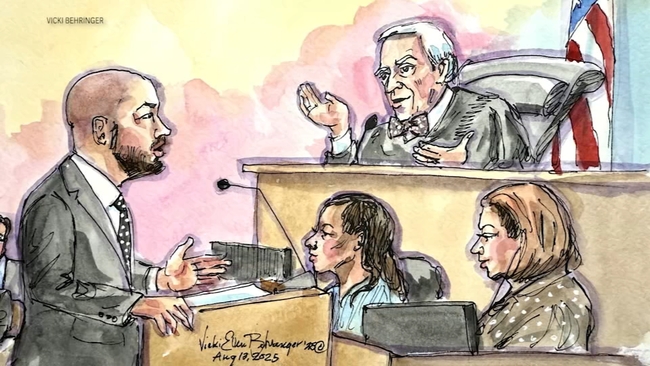
A three-day federal trial over President Donald Trump's deployment of roughly 4,000 National Guard troops to Los Angeles wrapped up on Wednesday.

A three-day federal trial over President Donald Trump's deployment of roughly 4,000 National Guard troops to Los Angeles wrapped up on Wednesday, with a judge pressing the administration to explain why hundreds remain there more than two months later, after June's immigration posts subsided.

California is asking U.S. District Judge Charles Breyer to rule that the troops violated federal law by performing local law enforcement duties -- and to block the president from sending soldiers into the state without legal authorization in the future.

On the final day of testimony, Breyer repeatedly challenged the Department of Justice's argument that the Guard is still there to protect federal authorities and property.

"What's the threat today? What was the threat yesterday? What was the threat last week, two weeks ago?" Breyer said. "It's the absence of any limits to the national police force. That's what I am sitting here trying to figure out."

Eric Hamilton, a U.S. Deputy Assistant Attorney General, argued the Guard was serving a "purely protective function," saying that when troops protect federal officers, it does not violate the Posse Comitatus Act -- the 19th-century law restricting military involvement in civilian law enforcement.

California's lawyers countered that the deployment marked an unprecedented overreach, calling it "an egregious violation and disregard for the law."

"In a nation that has a founding principle and policy against the use of the military for domestic purposes, there can be no real question that defendants could not accidentally or innocently violate the bar against military involvement," said Meghan Strong, a deputy attorney general with California Attorney General's Office.
The trial began as Trump ordered National Guard troops into Washington, D.C. on Monday to assist local police -- a move legal experts say underscores the broader stakes.

Breyer said he would rule "as soon as possible," which could be days or weeks. Either side is expected to appeal.
Aug 13, 2025, 9:20 PM GMT

Deputy AG with CA DOJ says federal government's arguments 'lack basic common sense'

Meghan Strong, the Deputy Attorney General with the California Department of Justice took the stand. She started off saying the federal government's arguments "lack basic common sense."

"The idea that state has no legal recourse to challenge the unlawful conduct of those troops, that defies basic principles of federalism."

There were notably far fewer questions from Breyer already on Strong's beginning remarks compared to Hamilton with the DOJ.

Now Strong responded to Hamilton's arguments that 12406 (circumstances when POTUS can federalize the Guard) is an exception to the Posse Comitatus Act.

Strong noted Marines are not included in this portion of the law and PCA applies, but further refuted the DOJ argument. She said PCA requires an express authorization (by Congress or Constitution) in specific cases and circumstances.

Breyer gave another history of the Posse Comitatus Act.

Strong said the Trump administration has "taken the state's own soldiers and ordered them to violate the law."

Strong referred back to the exhibits we saw from the Department of Defense with guidance for military about what counts as "civilian law enforcement activities" in violation of the PCA.

"Defendants are defying their own regulations in Los Angeles, and we think that satisfies the bad purpose and intent standard here."

Hamilton said the Department of Defense "was sensitive" to the Posse Comitatus Act, providing training and direction to the National Guard and Marine members in Los Angeles in order to stay in the confines of the law.

Breyer also brought up fact that some of the troops were brought along for other operations, like the marijuana groves outside of L.A. "I go back to the thing I am really troubled by, what limiting actions are there to the use of this force?"

Breyer went on to refute Hamilton's earlier point Wednesday that the 12406 statute Trump invoked to federalize the Guard is a Posse Comitatus exemption.

Judge: "Why did I spent a day looking at slide after slide, report after report, reports and regulations about the conduct of soldiers to ensure they are in compliance with (PCA), if it is irrelevant? Why did that happen?"

Hamilton said ongoing LA Guard deployment is a "purely protective function" and that is not something PCA prescribes.

Breyer: "So we are going to see federal officers everywhere if the president determines there is some threat of safety to a federal agent?"

Breyer said he isn't insensitive to safety of federal employees, but kept asking Hamilton what the limits of this deployment are.

There was a brief rebuttal from Strong with California. She noted ongoing Guard deployment of about 300 members in Los Angeles, saying that is still a significant presence.

"These violations are ongoing through today."

Judge Breyer said both sides had an "excellent" presentation and that he will decide this matter as soon as he can. Court dismissed.

Aug 13, 2025, 9:14 PM GMT

Deputy Assistant AG with the US DOJ answers questions on Posse Comitatus Act

Eric Hamilton, the Deputy Assistant AG with the U.S. Department of Justice, argued that the Posse Comitatus Act is a criminal statute, and there are no civil remedies. He was met with a round of questioning from Judge Breyer, who repeatedly asked: "What is the remedy? Is there a remedy for the violation?"

Breyer gave a hypothetical question to Hamilton, if facts were not disputable: If Trump told troops to conduct law enforcement activities in LA., what's the remedy?

The DOJ again said there's no civil remedy. Breyer noted there's presidential immunity from a criminal remedy, concluding it would be: "So it's too bad, so sad it's over. And that's the end of the case, even though it's violating allegedly other persons...what you're saying is here is a statute that basically under under the present jurisprudence that we have today, there would be no remedy."

Now, the DOJ argued the Posse Comitatus Act - which generally prohibits military from action as civilian law enforcement - does NOT apply to 10 USC 12406. Hamilton said, "The Act's texts contemplates that it will coexist with other statutes and there will be exceptions."

Breyer: "But (exceptions) are in context of an insurrection. Is it the federal government's position, that an insurrection (in LA) was happening?" The DOJ said no but referred back to 9th Circuit ruling in this lawsuit finding Trump lawfully federalized the National Guard under 12406.

Breyer then presses on differences between insurrection and rebellion, since 12406 allows POTUS to federalize the Guard in case of rebellion against fed gov't. Hamilton says Trump justified it as a rebellion, but notes that this trial is about Posse Comitatus Act alone.

Hamilton and the DOJ then argued California has no standing to sue. Roughly what he said as for each of California's alleged injuries: 1) allegation they have standing because of physical/economic health of their citizens, no one testified to prove that 2) Guard escalated tensions and reignited protests but they didn't trace that to PCA violation nor establish a record of that. A protest isn't even an injury in the first place. It's a 1A protected act. 3) fiscal harm, again doesn't trace alleged fiscal harms to PCA violation nor did the court hear any of this. 4) federalism injury - service members are in SoCal to protect feds from violent acts that constitute federal crimes. There is no injury to California.

Aug 13, 2025, 4:11 PM GMT

3rd day of Newsom v. Trump trial over National Guard to focus on 'legal issues' from parties

The third and final day in the Newsom vs. Trump trial over National Guard deployment to LA is about to kick off Wednesday.

U.S. District Judge Charles Breyer said Tuesday that he wants to hear more about the "legal issues" from parties today.

Eric Hamilton, Deputy Assistant AG with the U.S. DOJ is starting Wednesday/ "California is asking this court to do something that no court has ever done before...the statute authorizes the president to deploy guardsmen, but under their interpretation, that violates the Posse Comitatus Act."