2026 NFL trade deadline winners, losers: Kirk Cousins, Josh Downs, Bengals, more

TheNFL trade deadlinehas come and gone. I will forever remember it as the trade deadline in which the Bengals nearly accidentally traded a third-round pick forArnold Ebiketie(more on that below).
Identifying winners and losers on deadline day is always tough. The Titans, Howie Roseman and Josh Downswill be made winners and losers for their efforts today not by my words but by the picks they make or games they win over the next two or three years. Of course, we can grade the quality of their work now (spoiler, they are winners) -- but this isn't the real test. The real test is what comes next.
I have six winners and four losers from this year's trade deadline ranging from players to GMs. Let's dive in.
Jump to:
Cousins| Jefferson |Bengals
Downs |Roseman|Taylor| Poles
Titans| Chargers | Cardinals


Deadline winner: QBKirk Cousins
Cousins is about to have a quarterbacking season for the ages.
No, he won't set the passing touchdown record or anything. But let's trace the arc here.
Cousins started nine games for a 4-5 Raiders team that was waiting to turn the page to 2026 No. 1 pick Fernando Mendoza. The entire time he started, he comported himself with the exact attitude and perspective you'd hope to see from a veteran bridge starter.
"If I'm not the best option, then I don't want to be out there," Cousins said in late October after the Raiders' fourth straight loss. "The organization will do what they feel is best, but I feel that Fernando's done a great job and has a bright future ahead. I'm going to try to go out there and play as well as I possibly can to help us win and give him a great example to learn from until he does go out there eventually."
A beautiful quote. And it echoes what Cousins has said from the beginning: He was in Las Vegas to help the team win but to also give Mendoza an example of how to prepare, speak, compete and perform as an NFL quarterback. If Mendoza looks competent at any part of the 2026 season (and even beyond), Cousins will receive the share of credit due an angel investor. Even if Mendoza was always destined to play well -- he's the first pick, for crying out loud -- Cousins and the Raiders' patient approach with Mendoza will be lauded as a contributing factor.
So, Cousins has that going for him. His arc continues to Minnesota where the power of friendship welcomes him with open arms. Cousins was a Viking from 2018 to 2023, the last two seasons of which were spent under head coach Kevin O'Connell. The Vikings went 13-4 in 2022 with Cousins before he tore an Achilles midway through the 2023 season.
O'Connell's offense isn't just good for Cousins, it's almost built in his image. O'Connell was the quarterbacks coach with Washington in 2017, Cousins' final season on the team. As O'Connell's path split from Cousins then reunited with him in Minnesota, it has become increasingly clear how much O'Connell's passing game needs a fearless pocket quarterback with the processing speed necessary to handle all the various route adjustments -- not to mention the velocity to hit intermediate throws. Those features have always been the strength of Cousins' game.
Cousins isn't just reuniting with pals, though. He's joining a 6-2 Vikings team powered by the league's best and most unique defense. The bar for Cousins -- who is 38 years old and doesn't have as big of an arm as he used to -- has simply never been lower. Carson Wentz's Monday night performance against the Bills dropped it to the floor. So long as Cousins can keep the offense on schedule and manage the time-of-possession battle, Minnesota's defense can win multiple playoff games. It's that dangerous of a group.
What else? He gets to throw to Justin Jefferson.That's sick (see below). Cousins could become the first quarterback to start 18 games (the Vikings have had their bye and the Raiders haven't), so he might indeed get to set a record after all. What a season it'll be for Kirk Cousins.

Deadline winner: WR Justin Jefferson
Is there any individual happier than the Vikings' star receiver right now? No more barely contained frustration on the sideline while cameras follow his every facial expression. A competent quarterback returns to Minnesota -- one who speaks to this day about how throwing the ball near Jefferson is a path to success.
Since the start of the 2022 season, Jefferson has averaged 2.73 yards per route run on a 27% target rate when Cousins throws him the football. He has a catch rate of 70% and averages 103.5 yards per game. This season, he was at 2.16 yards per route run at a 30% target share -- the efficiency was way, waydown -- with 56.1 yards per game. Almost half as much raw production.
He's about to go nuclear with Cousins under center. You can bet the house on that.

Deadline loser: Bengals
If you have no idea what happened with the Arnold Ebiketie trade and the compensatory pick formula Tuesday morning, don't worry. You've come to the right place.
Ebiketie is a veteran edge rusher whom the Eagles signed to a one-year deal worth up to $7.3 million in free agency this past summer. Ebiketie was a regular free agent (i.e., not a player released or cut but whose contract expired with his old team), so he matters in the league's compensatory pick formula. Compensatory picks are additional picks awarded to teams at the end of the third, fourth, fifth, sixth and seventh round of the draft, and they are exactly what they sound like: compensation. When a team loses more qualifying free agents than it signs in a given offseason, it is awarded additional picks based on the value of the players it lost.
Here's a good example. The Packers lost the following players in free agency in the offseason: Malik Willis (who signed a deal worth $22.5 million in average value with the Dolphins), Quay Walker ($13.5 million), Romeo Doubs ($17 million), Kingsley Enagbare ($9 million) and tackle Rasheed Walker ($4 million). The OverTheCap compensatory pick selections, which are run by a guy named Nick Korte (remember the name!), projected those losses to be worth a third, a fifth, a fifth, a sixth and a seventh, respectively.
The Packers signed only one qualifying compensatory free agent on the other side of that scale: cornerback Benjamin St. Juste for $5 million. St. Juste cancels out one of the Packers' incoming compensatory picks -- in this case, it'll be Walker and the seventh, as that's the pick with the most similar value to St. Juste.
Now that we understand how compensatory picks work, let's take a look at the Bengals. They lost three free agents in Trey Hendrickson, Joseph Ossai and Noah Fant. They signed two in Bryan Cook and Boye Mafe. But when they tried to trade for Ebiketie, they were acquiring a third player who would have counted against them in the compensatory pick formula. He would have cancelled out their one outstanding comp pick, most likely the third-rounder they were in line to receive thanks to Hendrickson's departure.
We know this because Korte posted it to social media shortly after the Bengals' trade for Ebiketie was announced.
And then, shortly after Korte's post ... it was reported that the Bengals were backing out of the Ebiketie trade.
There are a few things to say here. The first is that, had the trade gone through, the Bengals would still have been listed as losers because they lost a third-round pick acquiring a depth edge rusher. That was the worst-case outcome for Cincinnati, and the team successfully avoided it.
The second is, even as the Bengals successfully avoided disaster, it is extremely embarrassing to have disaster avoided by a social media post from a cap analyst. The compensatory pick formula is notoriously weird and tricky, but teams have been manipulating it for years now. Multiple teams told me they have in-house software to test moves before they make them to ensure they aren't hurting themselves in the comp pick process. The Bengals either don't have these processes or had a mistake in their process, and their lack of preparedness was caught in glaring light. This was an easily avoidable and needless trip over their own shoelaces.
The third is that Zac Taylor was Monday asked about making moves before the trade deadline and said the Bengals would do, "Nothing ... we're good." And after it's all said and done, he was right!

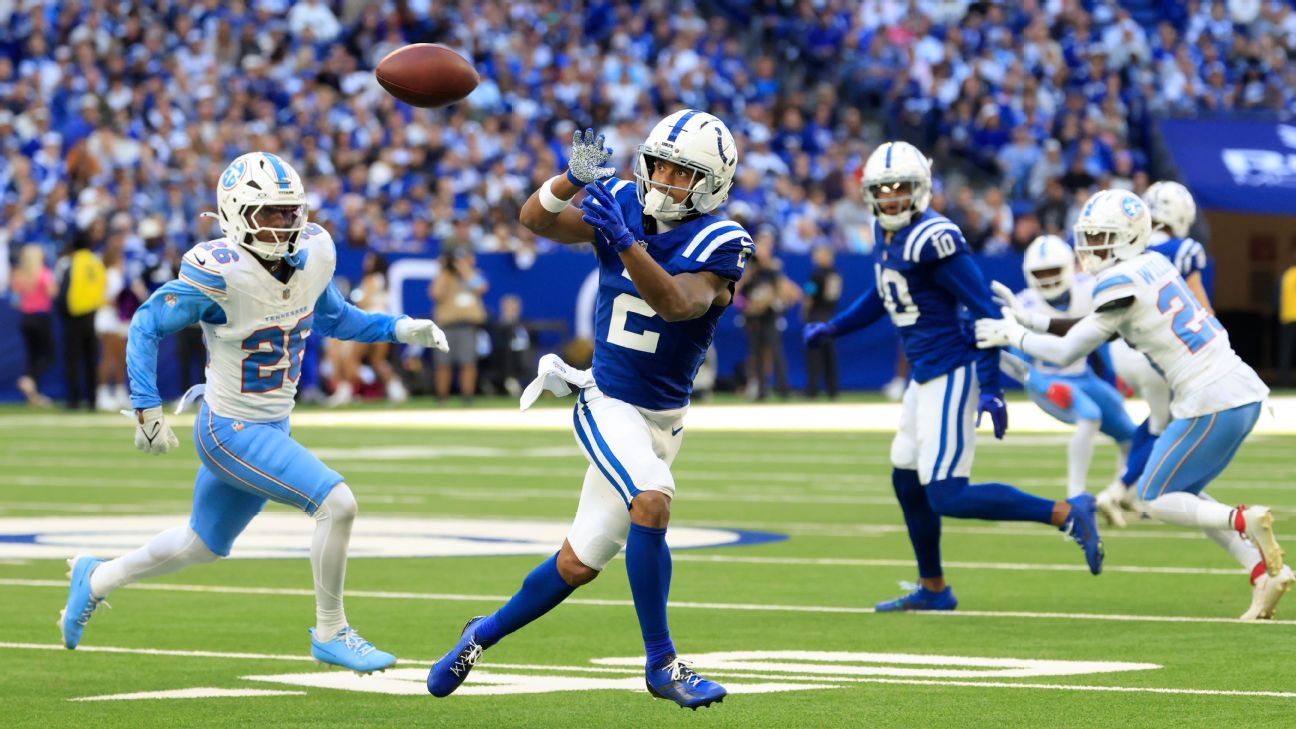
Deadline winner: WRJosh Downs
Can you imagine the feeling of getting out of Indianapolis and arriving in Kansas City? Like getting home after a long road trip. Like seeing your high school friends for the first time since you all left for college. Or, perhaps, like Vince Carter the moment his jersey was retired by the Toronto Raptors. If you don't believe me, hear it from the man himself.
Downs wins the award for best environmental improvement at the 2026 deadline, as he goes from an offense 31st in EPA per dropback and 32nd in explosive pass rate to an offense that ranks eighth in EPA per dropback and seventh in explosive pass rate.
Downs is largely innocent in the investigation of what went wrong with the Colts' passing attack: the injury to receiverAlec Pierce and the play of quarterbackDaniel Jones have been the biggest culprits. In Kansas City, Downs will be worryingly as integral to the passing game as he was in Indianapolis, as both teams sorely lack wide receiver depth. But Mahomes is so much more capable a passer than Jones, and the stylistic fit is much better as well: No team throws more screens and quick passes than the Chiefs, which will serve Downs' separation ability from the slot well.
Downs doesn't just join a contender with the potential to save its offense and hold the Lombardi trophy. He's in a contract year, and with the Chiefs' passing attack full of available targets, he could put up career numbers down the stretch. Downs can make millions in 2027 free agency should he produce as the Chiefs need him to. Had Downs become a Steeler, that path to sudden richness would have been more narrow.
I personally don't think Downs has enough talent as a downfield or contested catch receiver to reach the billing the Chiefs need him to. But it's worth the swing for only an exchange of Day 3 picks.

Deadline winner: Howie Roseman
When the Eagles got a 2027 first-round pick and 2029 second-round pick for defensive tackle Jordan Davis, the collective groaning sound you heard immediately afterward was the NFL media machine at large repeating one familiar phrase: Howie season.
The Eagles' general manager is known for winning trade deals, and he did it again with this one. To get a first- and a second-round pick for Davis, who has been an early-down run stuffer without much pass rush value to this point in his career, is astonishing work. At last season's trade deadline, Quinnen Williams returned first- and second-round picks as well -- arguably a better first, in that it was the better of the Cowboys' and Packers' 2027 picks. Before this season's deadline, Jeffery Simmons returned the Titans' two first-round picks. Simmons leads all defensive tackles in sacks (six), and Williams is tied for third (five). Davis is tied for 35th with 1.5.
Davis was extended in March by the Eagles after a career-best 2025 season in which he was fourth among defensive tackles in run stop rate and run stop EPA. In the Vic Fangio defense, he made light boxes work on early downs, then got off the field for better pass rushers (such asMoro Ojomo, whom the Eagles can now extend) on later downs. In that he was in better shape and playing faster, Davis had 56 third-down pass rush snaps in 2025 -- more than he'd seen in his first three seasons combined. The Eagles gave him a large extension -- three years, $78 million -- in anticipation of him filling a big role down the stretch.

Because Roseman signs early extensions (Davis still had a fifth-year option to play on) and uses future bonuses as built-in restructures, the Eagles were able to suddenly shift gears and trade Davis on the extension instead of keeping him on the books. Had they not gotten that extension done, Davis would have been in a contract year and the Eagles never would have gotten as much trade capital back from the Jaguars. This is the advantage of having a long-term-thinking general manager who has unprecedented job security -- he can value 2029 draft picks and use future money to make optimal decisions now.
This was another day on a long list of days that Roseman has won. I'd love to have a clever zag take about why his reputation is bigger than his results, but it isn't. He has the longest view in the room and knows how to pivot off old moves fast. Roseman won the day.
It could have been even better if the Ebiketie trade to the Bengals went through -- not because the Eagles would have gotten any more picks out of it but simply because it would have been pretty funny.

Deadline winner: Ryan Poles
It's important to evaluate trades in a vacuum, and two firsts for Simmons was a steep price no matter which way you slice it. But it does bear saying: That trade looks so much less expensive when you see the price the Jaguars paid for Davis, a player who simply (1) does not play as many snaps as Simmons, (2) does not play as many high-value snaps as Simmons does, (3) is not as productive as Simmons on the snaps that they play and (4) has not produced as consistently as Simmons has.
The Bears' GM moved all-in for a defensive tackle just like James Gladstone and the Jaguars did. The playoffs will decide how history views these trades. But the Bears sure got a lot of cover this week, and that's never a bad thing

Deadline loser: RBJonathan Taylor
I feel bad for Taylor. The Colts reportedly got offers centered on a second-round pick and with additional capital behind -- that's a fair price for Taylor -- and they passed on those deals in the hope of bigger returns.
Angling for a Christian McCaffrey-esque package -- that's a second, a third and a fourth -- was a reasonable negotiating tactic but never should have been the bar to clear. McCaffrey has a much, much bigger impact on the passing game than Taylor does. McCaffrey was 26 years old when the Panthers traded him to the 49ers in 2022 and had 1,059 touches over 4 seasons. Taylor turns 28 in January and has 1,925 touches over his seven seasons. The age cliff is likely coming for him soon.
Now Taylor is stuck on a Colts offense that will look a lot like the offense he endured in the winter last season: so totally incapable of throwing the football that Taylor will have no room to run. The contenders he could have joined -- the Broncos, Packers, Vikings or Bengals -- all have legitimate runs to the Super Bowl. Taylor could have been the final piece to the puzzle in all of those spots. Given just how talented he is as a big-play runner, I would have believed it, too.
The Colts are in for a long and brutal rebuild in that they're missing their 2027 first-round pick because of the Sauce Gardner trade. Taylor might not be in Indianapolis for all of it, but he is for at least the next seven months. He's a fun player stuck in a bad spot.

Deadline winner: Titans
The Titans are filling the coffers, and rightfully so. After sending Simmons to the Bears for two first-round picks, general manager Mike Borgonzi kept the train rolling by sending Amani Hooker to the Bills for a second-round pick. The Titans now have four top-64 picks in the 2027 draft.
That level of flexibility will be huge for them as they determine what to do at quarterback. Second-year passer Cam Ward played the best ball of his NFL career when last we saw him -- a Week 8 late-game loss to the Bengals -- but he'll need to stack several of those days to prove he has turned a corner and deserves to enter Year 3 unchallenged as the Titans' starting quarterback.
If there's any uncertainty around Ward, the one-win Titans will evaluate the QB draft landscape (and maybe even the QB trade market, with that extra first in 2028 as additional ammunition). They aren't certain to move on from Ward, but they'll have the resources necessary to move around in the draft if they'd like to.
Of course, it is worth noting that the two best Titans defenders are no longer Titans defenders. Hooker doesn't have the same name recognition that Simmons does, but he's an impactful center-fielding safety with range and ball skills, and he has enough size and stopping power to play down in the box. Tennessee has some exciting young players on defense (Anthony Hill Jr. and Kevin Winston Jr.) to grow with, but it's always sad to see homegrown talent get out of the building without much hardware to show for it. Hooker and Simmons were classmates of the 2019 draft (alongside receiver A.J. Brown) and went to three straight postseasons under coach Mike Vrabel but never saw a Super Bowl. These trades are wins for the future but reminders of the failures of the past as well.

Deadline loser: Chargers
I was fully prepared to name the Chargers a loser of the 2026 deadline if they moved no players, as the reporting expected. The ice thawed late on Tuesday as they considered dealing some of their expiring contracts: Khalil Mack, Tuli Tuipulotu, Dalvin Tomlinson, Donte Jackson ... and maybe Daiyan Henley.
On that list of players, I would have had two functionally untouchable players: Tuipulotu and Henley. Yet, of all the trades they could have made, the Chargers sent Henley to the divisional rival Broncos (!) for two Day 3 picks.
Of all the trades to make, the Chargers made this one? Henley hit as a third-round pick as an undersized linebacker thanks in large part to his success in coverage. Since the start of 2024, when he became a full-time starter, Henley has been targeted 175 times (third among all linebackers), per Next Gen Stats. He has given up two touchdowns to four interceptions with 15 total passes defensed. He's surrendered a passer rating of 82.9 (fourth-lowest) and only 6.3 yards per target (11th-lowest). His recent play has been more inconsistent than years past, and there are tackling limitations in the box on a player of his size. But this is a good coverage linebacker in a passing league.
I can only imagine the Chargers anticipated not paying Henley in free agency, as he has only one year left on his deal, and traded him for picks while they still could. The Broncos are thrilled by this -- coverage linebacker has been a huge issue for them going back to last season, and a divisional opponent just gave them one for Day 3 capital.
I just cannot get my head around the idea that the 0-8 Chargers would make no major moves at this deadline despite the clear need for a total teardown and rebuild ... but then pivot to trading a productive young linebacker for minimal capital. Now they'll continue to run Mack and Jackson and other tradable players for the rest of the season ... and likely get precious little from their departures in 2027 free agency. Poor team building.

Deadline loser: Cardinals
There were a few squads who looked like potential big traders as we approached the deadline. The Titans were certainly one, and though they didn't move Tony Pollard or Calvin Ridley, they got some deals done. The Chargers, whom I called losers above, at least made one deal with Daiyan Henley to the Broncos. The Colts could have made bigger splashes with Daniel Jones and Jonathan Taylor, but made four deals over the past month, so that's fine.
The Arizona Cardinals dealt Marvin Harrison Jr. a month ago, which should not go unremembered. They found a deal for Jacoby Brissett when the Ravens were desperate for a bridge quarterback. But other than that, as the deadline ticked down ... they stood pat.
I think this is a silly missed opportunity. The Cardinals are 3-6 and have shown some life this season with big upset wins over the Rams and the Cowboys. I like a lot of what head coach Mike LaFleur has delivered on offense. Defensively they remain a poor unit across the board -- 32nd in EPA per play, 30th in points per drive allowed -- but at least the offense has kept them in some fights.
Yet the offense is broken now. Michael Wilson is on season-ending injured reserve with a neck injury, and QB2-become-QB1Gardner Minshew IIis likely to follow him with a UCL injury in his throwing arm. The Cardinals are down two starting offensive linemen, three starting receivers, both veteran quarterbacks and rookie third overall pick Jeremiyah Love on their Week 1 offensive depth chart.
Why, in a market of preposterous safety interest -- bothJessie Bates IIIand Amani Hooker garnered second-round picks via trade this week -- would you continue to hold on to Budda Baker? Why, in a market without great edge rusher options, would you hold the best tradable edge rusher in Josh Sweat?Not only is the season functionally lost given all the offensive injuries, but the defense has been very poor. A new coordinator might step in for Nick Rallis next offseason. Baker and Sweat are both aging players (30 and 29 years old, respectively) who might not fit as well in the next version of the Cardinals' defense. They also might be beyond their prime by the time the Cardinals next become competitive.
So many teams are well-equipped for aggressive rebuilds with multiple early selections. The Jets, the Eagles, the Titans. And here come the Cardinals with one future second thanks to the Harrison deal. Other than that, they have only their own Day 1 and 2 picks for the next three seasons. Missed opportunities this week.

Deadline loser: Me ... in bingo
I need a ruling from the people.
I play deadline bingo every year, and this year, we almost won on two different lines. Another defensive tackle deal (after the Davis trade) would have brought us home vertically, and a reunion between a player and an old coordinator would have taken us home horizontally.
When I made that square, I was thinking of the classic "Jaelan Phillips to the Eagles reunites with Vic Fangio" or "Rashid Shaheedto the Seahawks to rejoin Klint Kubiak." You all know the sort of trade I'm talking about. Explicitly made so a player can follow a coach.
I was not thinking about Kirk Cousins reuniting with an entire franchise when he returned to Minnesota for a third-round pick. He's getting a familiar head coach in Kevin O'Connell, a familiar offensive coordinator in Wes Phillips, a familiar cafeteria employee, everything. It's a total return to an organization he left only three years ago.
Also of note: Falcons center Ryan Neuzil, traded at the absolute buzzer, follows OL coach and running game coordinator Dwayne Ledford to the Ravens. Not technically an OC ... but so close!
Counts? Doesn't count? I lean no, but maybe I'm being too serious about my own made-up trade deadline bingo game. Reach out to me on socials if you feel strongly about the ruling here either way.
]