Rep. Ro Khanna's anti-elite message fuels Silicon Valley backlash and 2028 buzz


SAN JOSE, Calif. (KGO) -- Rep. Ro Khanna is betting the political moment is shifting - and that he's one of the Democrats best positioned to meet it.
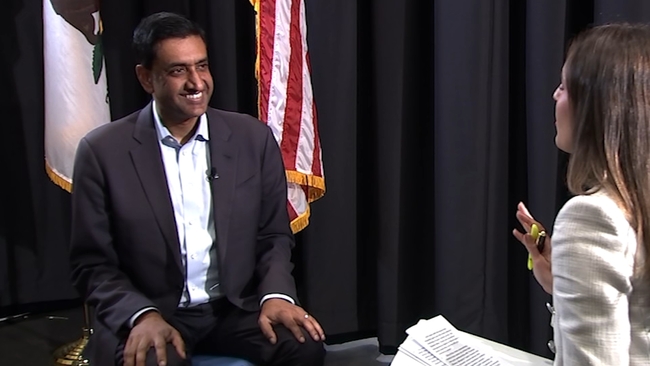
In a wide-ranging interview with ABC7 ahead of a Saturday town hall, the Silicon Valley congressman framed his recent work as part of a broader effort to tap into rising frustration with the country's most powerful institutions.
"People are so upset at the status quo," Khanna said. "They realize that this Epstein class has been in it for themselves, that their lives aren't improving."
Khanna has tried to translate that message into action in Washington, most notably through his push to force the Department of Justice to release documents tied to convicted sex offender Jeffrey Epstein.
"What we've found is some of the most powerful and connected men in our country participated in the abuse or turned a blind eye," he added. "This is about justice."
WATCH: Full sit-down interview with Rep. Ro Khanna
A populist coalition and strange bedfellows
That effort has produced one of the more unlikely alliances in Congress: a Silicon Valley progressive teaming up with Rep. Thomas Massie, a Kentucky Republican. It's a pairing that, until recently, would have been politically unthinkable.
At key moments, they also aligned with former Rep. Marjorie Taylor Greene, who helped build public pressure in defiance of Republican leadership initially resistant to forcing the DOJ's hand.
For Khanna, that coalition is the point - proof that frustration with elite power is cutting across party lines.
"It's about going after elite impunity. There's a sense in this country that rich and powerful people with connections don't play by the same rules. There needs to be one system of justice," Khanna said.
He argues that same dynamic could extend beyond a single issue, pointing to areas where he sees potential alignment: accountability for elites, reducing foreign military involvement and rebuilding the U.S. economy.
RELATED: Here's the potential impact a proposed CA billionaire tax could have on Silicon Valley
Running against his own backyard
But as the delegate for America's wealthiest congressional district, Khanna is making that case from an uneasy perch.
His district encompasses some of the most powerful tech companies and billionaires worldwide - the very concentration of wealth he now warns is destabilizing the country.
"We're living in a new Gilded Age. Nineteen billionaires have 12.5% of the economy, $3.5 trillion. That is three times what the concentration was during Rockefeller and J.P. Morgan and Vanderbilt," Khanna said.
His solution: a "new social contract" funded in part by taxing billionaires' assets.
"Having billionaires pay a modest tax so that we can have health care and childcare and education makes sense," he said. "Otherwise, you're going to have people with pitchforks against the wealth concentration."
At the same time, Khanna is threading a careful political needle.
"I don't have a problem with billionaires," he said. "That's where I call myself a progressive capitalist."
"What I'm trying to do is build a unique coalition - business leaders, labor leaders, technology leaders, progressive leaders - to have an economic renewal of this country," he added.
That balancing act is now facing its clearest test yet.
RELATED: Silicon Valley entrepreneur Ethan Agarwal launches challenge to Rep. Ro Khanna
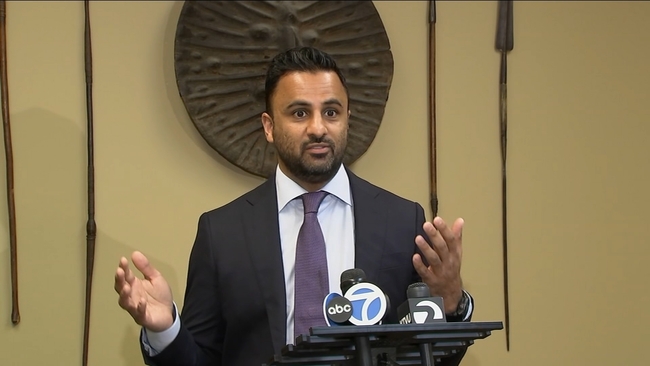
Last month, Silicon Valley entrepreneur Ethan Agarwal launched a Democratic primary challenge against Khanna, backed by some tech leaders and centered in part on criticism of Khanna's support for a proposed wealth tax.
The challenge underscores a growing tension: whether Khanna's anti-elite message can coexist with the political and financial ecosystem that helped fuel his rise.
Khanna dismisses the idea that Silicon Valley is uniformly opposed to his agenda.
"There are a lot of tech leaders. They may not be on Twitter or in public, but they tell me privately, 'Ro, we're happy to pay a modest amount for health care and childcare for everyone. We just want to make sure there's no fraud. We just want to make sure there's no waste,'" he said.
Still, he acknowledges the contradictions in his own district.
"When you look at my district, people are rent-burdened. They can't afford rents. They can't afford housing, they can't afford some of the groceries, they can't afford childcare. And yet you have this incredible wealth concentration. But folks who are living there, they are having a tough time," Khanna said.
Khanna tests 2028 messaging
The congressman - largely considered a Democratic contender for president in 2028 - stopped short of outlining future political plans, but spoke in terms that extend beyond a single House race.
"I believe that there's going to be a moment where people want honesty, integrity, someone who has stood up to the system and a real path, a real economic vision for the future," Khanna said.
"And whether it's me or someone else, my hope is that the Democratic Party will offer that platform."
It's a test of whether a message centered on inequality, accountability and distrust of institutions can reshape not just his district, but the direction of the Democratic Party.
"If we continue to allow islands of prosperity in places like Silicon Valley...and have seas of despair across the country, we're going to tug at the fundamental social fabric of this nation, and you will have anger, populist anger, that hurts the country," he said.
"We're going to take on this corrupt system, and we're going to offer an affirmative vision that's going to give this country a new national purpose, bring us together, and have America really have its best days ahead."