Here's where CA governor candidates Steve Hilton, Xavier Becerra stand on homelessness
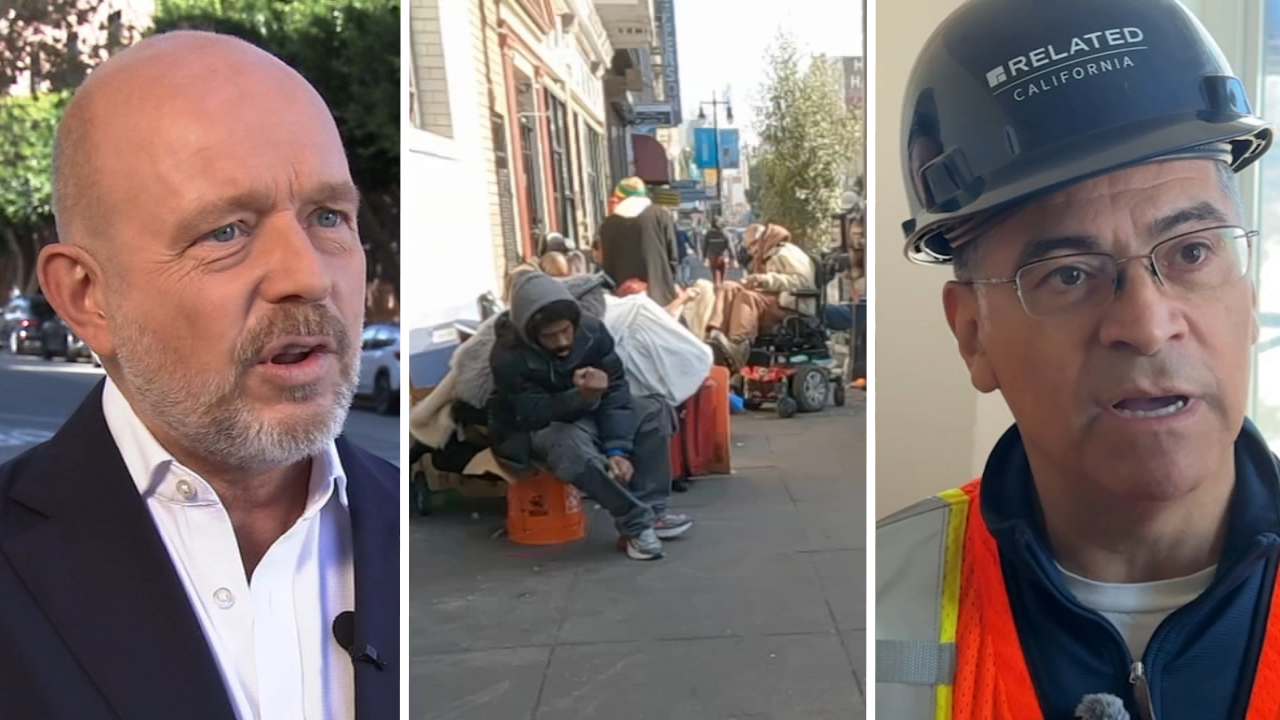


SAN FRANCISCO (KGO) -- Republican gubernatorial candidate Steve Hilton is making an ambitious promise to California voters on one of the states most visible issues.
Within his first year in office, Hilton says he can effectively end mass homelessness in a state where roughly 180,000 people remain unhoused.
It's a pledge that would require a dramatic overhaul of California's approach to one of its most persistent political challenges, and one that puts Hilton at odds with Democrat Xavier Becerra over how the state should spend billions of taxpayer dollars addressing the crisis.
In an interview with ABC7 on Monday, Hilton outlined plans to establish a statewide network of large-scale homeless recovery centers, eliminate funding for certain existing programs and use law enforcement to clear encampments when people refuse assistance.
When asked whether eliminating encampments across California is realistic, Hilton was unequivocal.
MORE: Xavier Becerra expands lead over Steve Hilton in California governor's race, poll shows
"Yes, it is," he said. "It's not just possible. It's essential."
Hilton clarified that his goal of ending mass homelessness does not mean eliminating homelessness altogether. Rather, he wants to dramatically reduce the sprawling encampments that have become a fixture in cities across the state, including San Francisco, Los Angeles and San Diego.
His proposal calls for as many as 30 recovery centers, each with the capacity to accommodate approximately 5,000 people. Together, those facilities could provide temporary shelter for roughly 150,000 people, along with mental health treatment, addiction recovery services, job training and other assistance.
The Republican pointed to a proposed site on unused federal military land near Marine Corps Air Station Miramar in San Diego as a potential model. Hilton said discussions are underway with people involved in the project and the federal government.
"We're not talking about building apartment buildings," Hilton said. "This is temporary shelter, but the most important point is it's safe and clean and away from the conditions that have kept people trapped in homelessness."
Election 2026: A Guide to California's Ballot Propositions
The plan raises significant questions about how quickly the state could establish facilities of that scale, secure suitable land and provide the staffing and services needed to operate them. Hilton has not provided a detailed statewide construction timeline or cost estimate.
He argues California already spends enough money on homelessness and should redirect existing resources rather than continue funding programs he considers ineffective.
That includes a proposed shift away from the state's Housing First approach, which prioritizes access to permanent housing without requiring sobriety or treatment as a precondition. Hilton also wants to end funding for harm reduction programs, arguing they enable addiction rather than address its underlying causes.
Harm reduction programs can include distributing sterile syringes and providing access to medications such as methadone, an evidence-based treatment for opioid use disorder. Hilton has characterized such programs as taxpayer-funded incentives for continued drug use and says the state should focus on supporting recovery-based services.
"The best benchmark for showing that someone's got their life back on track is a steady job," Hilton said, describing employment as the ultimate measure of success for his proposed centers.
But he acknowledged that reaching that milestone could take years for some individuals, even as he maintains that mass homelessness could be substantially reduced within his first year.
Hilton also said his facilities would be designed to address practical barriers that keep people from entering shelters, including restrictions on pets and the challenges of accommodating people with vastly different needs in the same setting.
When asked what would happen to people who refuse assistance, Hilton said he would prefer voluntary cooperation and mental health treatment first but would ultimately support law enforcement intervention.
The Republican's sweeping promises come as California continues to face scrutiny over its homelessness spending. A 2024 state audit found that California had not consistently tracked the outcomes of major homelessness programs, making it difficult to determine whether billions in public spending were producing measurable results.
Hilton blames the state's Democratic leadership for allowing the problem to persist.
"I think that this is one of the things that you get from one-party rule," he told ABC7. "They kind of give up trying to deliver results because they don't feel that pressure from the voters."
He said he would meet with mayors during his first week in office to establish timelines and coordinate efforts to reduce homelessness, while using the governor's budget authority to redirect state funding.
Becerra says prevention is key
Becerra, meanwhile, is emphasizing a different starting point: preventing Californians from becoming homeless in the first place.
At an affordable housing event in the East Bay on Monday, ABC7 asked the Democratic candidate what measurable results voters should expect during his first year in office, particularly given the state's history of spending billions without consistently tracking outcomes.
Becerra argued that keeping people housed after a financial setback or medical emergency is considerably less expensive than helping them recover after losing their homes.
"We have to do everything we can to prevent them from falling into homelessness," Becerra said.
The former U.S. Health and Human Services secretary also called for clearing encampments while ensuring that displaced individuals have access to temporary shelter, mental health care and substance use treatment.
And he pledged to hold organizations receiving state homelessness funding accountable for their results.
"If you're helping address homelessness, then we'll scale you up," Becerra said. "But if you got money and you didn't do anything, we'll have to close you down."
Becerra did not provide a specific first-year numerical target in his response to ABC7's question.
Program funding remains divided issue
The exchange highlights a central tension in the governor's race: both candidates say California must demand greater accountability for homelessness spending and move people off the streets, but they differ on which programs deserve continued investment and how aggressively the state should pursue enforcement.
The latest statewide estimate puts California's unhoused population at roughly 180,000, down approximately 3% from 2024. Despite that decline, the scale of the crisis remains a major concern for voters.
A recent Public Policy Institute of California survey found nearly eight in 10 Californians are concerned about homelessness in their local communities. However, the share who describe themselves as very concerned has fallen to 37%, a significant decline from nearly 60% in 2019.