Plant native to Western Europe invades Novato Baylands restoration project

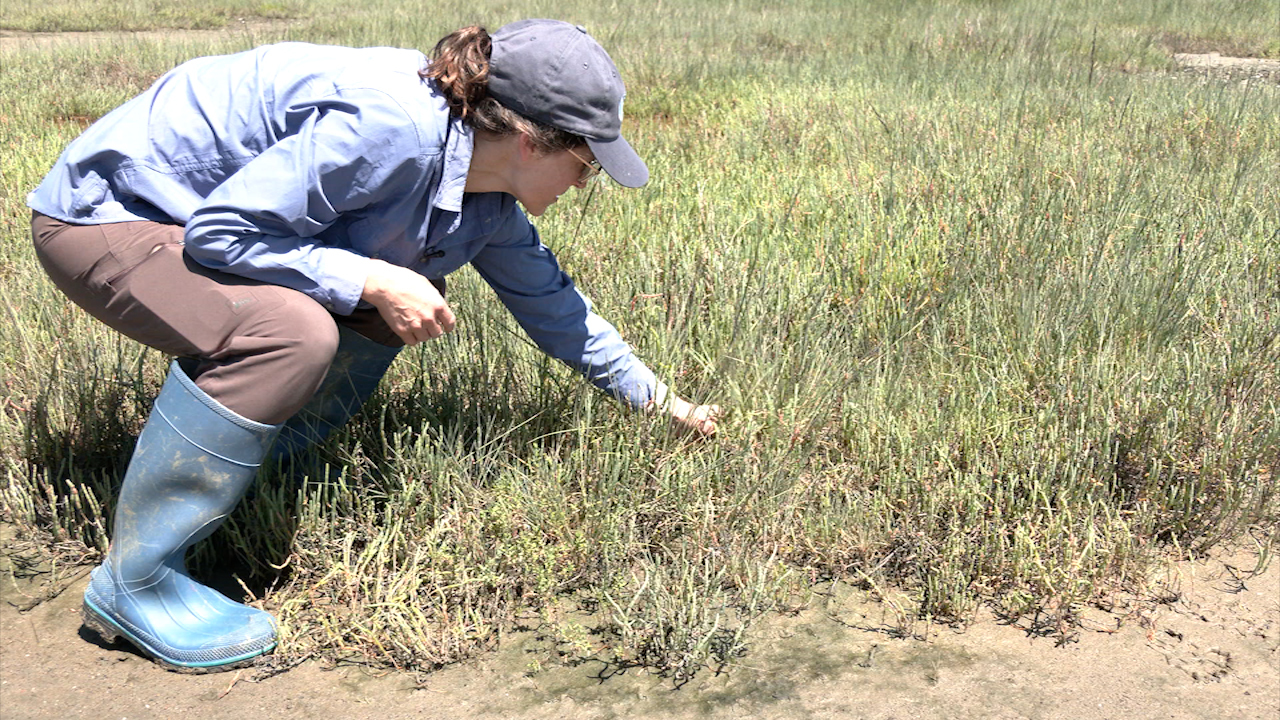
NOVATO, Calif. (KGO) -- Viewed from above, the Novato Baylands looks like a colorful quilt of blooming shoreline plants. But on the ground, a sharp set of eyes locked onto one species that stood out -- mainly, because it shouldn't be there.
"Yeah, so it is right here," said Leia Giambastiani, restoration manager with Point Blue Conservation Science, which manages the Baylands.
A lab analysis confirmed the plant she's pointing out is a non-native species known as Puccinellia Maritima. Native to Western Europe, experts say it's the first time it's been discovered in the North Bay.
Giambastiani said she was checking up on a stretch of shoreline when she first flagged the newcomer.
"And I saw this grass growing there that isn't normally there. I'd never seen it before. And it's unusual for a grass like that, a bunch of grass to be growing in a marsh area," she said.
MORE: 'Living' levee in Palo Alto Baylands aims to solve multiple problems with one-of-a-kind solution
And the fear is that over time, it could crowd out species like native pickleweed and other plants that support a wide range of wildlife from the Ridgway's rail to the salt marsh harvest mouse.
"It is a food plant that salt marsh harvest mice can eat, and it will actually create peat layers of vegetation. So, it can grow on top of other pickleweed and start with -- that's what a marsh is made up of, is layers of vegetation, dead vegetation on the bottom, and then it continues to grow and makes this really spongy, amazing habitat," she said.
Alejandro Rosales is working with Giambastiani to track the scope of the invasion, drawing virtual polygons on a laptop program he uses to keep track of the density and location of the spiky interlopers.
"And so, yeah, early detection and rapid response. That helps us out in figuring out how extensive this invasion would be. And so, we go out into the field. We take the tablet or even our phones and utilize the field maps, or ArcGIS, in order to map out where these weeds are and kind of get an idea throughout the site of how extensive or how bad the problem is," Rosales said.
And true: invasive species are already a growing problem along much of the shoreline of San Francisco Bay. Experts believe many exotics were carried into the Bay over the decades by incoming ships. And while the source of this latest discovery in the North Bay isn't certain, it comes at a challenging time for a project that's been nothing short of an environmental success story.



MORE: Salmon spotted in Bay Area creek, marking return for 1st time in decades after restoration project
"They filter out sediments. They really trap debris in them and have a lot of benefit to our community," Giambastiani said, explaining the multiple benefits of the tidal marsh.
Novato Baylands was restored from the former Hamilton Field Air Force base, and it's scheduled to expand along the adjacent shoreline in the upcoming years. Experts say eradicating Puccinellia Maritima could involve a combination of carefully tested herbicides and potentially hand removal in accessible areas.
But Giambastiani says the overriding goal will be to protect the delicate balance of a tidal marsh that embodies a decades-long battle to restore the natural shoreline of San Francisco and San Pablo bays.
"We've lost over 90% of the marshes in San Francisco Bay, so we're down to a much smaller 10% of what they were over 100 years ago. And so, every marsh that we have, I think is really important," Giambastiani said.
The good news is that environmental scientists do have a lot of experience with this kind of challenge. An ongoing project is already underway to control a plant called Spartina that threatened to crowd out existing species along many parts of the bay shoreline.