Stanford Medicine Cancer Center to launch proton therapy system for targeted cancer treatment


PALO ALTO, Calif. (KGO) -- Stanford Medicine is preparing to launch a compact proton therapy system that doctors say could mark a major shift in how tumors are treated.
In a futuristic room at the Stanford Medicine Cancer Center, a volunteer recently stepped into what the hospital describes as a first-of-its-kind device. The system delivers proton therapy, a specialized form of radiation.
"The advantage of proton therapy is that it allows us to concentrate radiation dose in tumors, and less in the surrounding normal organs," said Dr. Billy Loo of Stanford Medicine.
Developed by Mevion Medical Systems, the technology can rotate and move patients into precise positions to target different areas of the body while sparing nearby tissue.
To understand how compact the new system is, Stanford points back to earlier generations of proton therapy machines. In 2009, one of the few operating systems in the country was located at UC Davis.
It relied on a World War II era particle accelerator known as a cyclotron, originally developed at Berkeley and later moved to Davis. The machine was encased in concrete several stories high.
MORE:Stanford researchers testing biochar to expand carbon removal potential
"Proton therapy historically has always involved very large machines, meaning that you have to essentially build a new building around it," Loo said.
Behind a door at the Stanford clinic, the new system shows how far the technology has come.
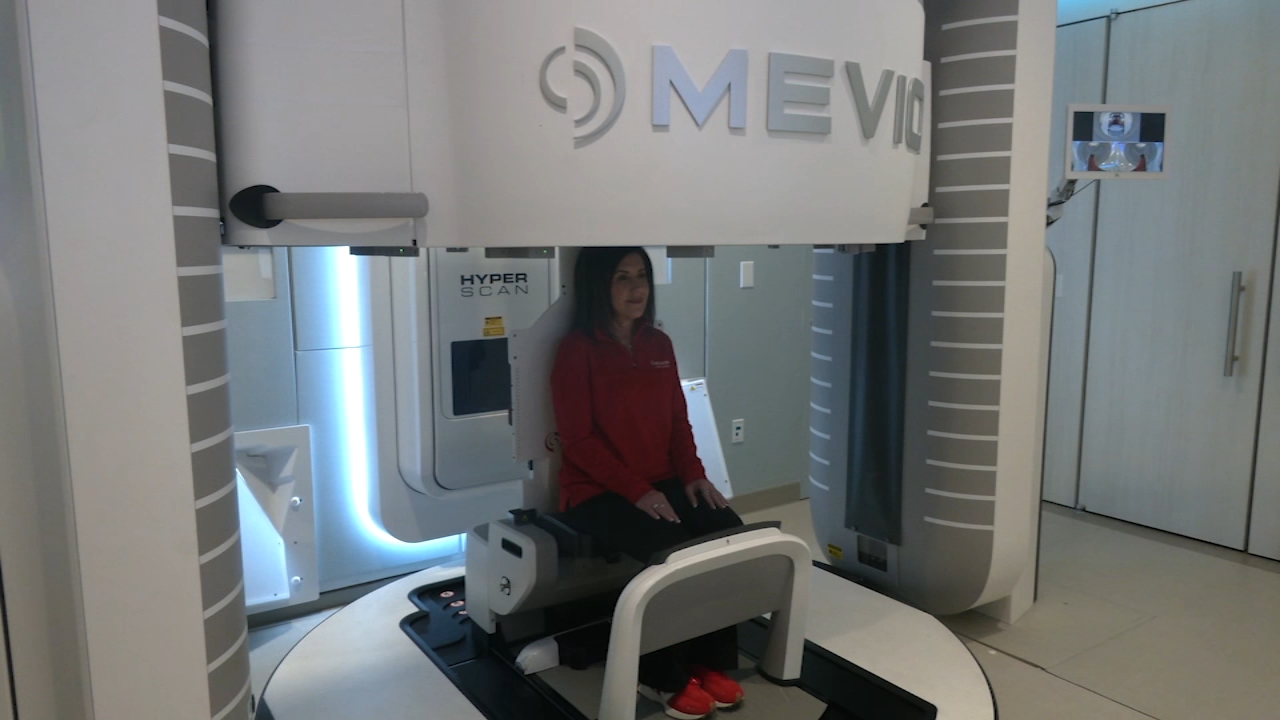
"Yeah. It's the same basic concept. However, it's basically miniaturized. Because of the design using superconducting magnets," Loo said.
Dr. Susan Hiniker, director of pediatric oncology at Stanford Medicine, said the treatment could be especially important for young patients by reducing long-term side effects.
"It's really this whole white part that's the tumor," Hiniker said while demonstrating the system.
"Exactly. It's a whole other set of things that we need to think about when treating a child, including effects on growth. And as part of the long-term toxicity profile. You know, these are kids. We want them to live 90 more years, and they may be dealing with the effects of treatment. For the rest of their lives," she said.
MORE: 'The best day ever': 2-year-old South Bay girl celebrates end of cancer treatment
Stanford's team believes the clinic will also make proton therapy more accessible for lower-income families who previously had to travel long distances for treatment. The technology, developed in the Bay Area decades ago, is now returning in a modern, scaled-down form.
The Stanford team is still working with the manufacturer on final preparations and expects to begin treating patients as early as this summer.