Stanford scientists believe climate change expanding range of disease-carrying mosquitos
Research also revealed some species are more adaptable to temperature changes than previous thought, hatching earlier


STANFORD, Calif. (KGO) -- Deep in rural Costa Rica, Stanford researcher Dr. Erin Mordecai's team is busy collecting mosquitoes. Literally vacuuming them off the dense tropical foliage. It's typical of the fieldwork that's helping them predict where varying species, and the diseases they transmit, may be heading.
"We can see which mosquitoes are present. How abundant are they? What types of habitats are they using? And importantly, is it the Aedes aegypti or Aedes albopictus mosquito that's really responsible for transmission of dengue and also of chikungunya and Zika and yellow fever in Costa Rica, says Mordecai.
While those names might not be familiar here in the Bay Area yet, one species, Ades Aegypti, is already introducing itself, gaining a foothold in California over the last decade or so. And recently, the state began seeing its first locally acquired cases of dengue fever. A potentially fatal disease that's reached epidemic levels in some tropical countries.
"And in fact, for the first time a couple of summers ago, we saw dengue transmission in Southern California and in several locations around California. So increasingly we're worried in the state that the virus is going or these viruses are going to be able to get established in our local mosquito populations, particularly as the summers start getting warmer," explains Mordecai.
MORE: CDC issues travel health notice for mosquito-borne chikungunya virus in China
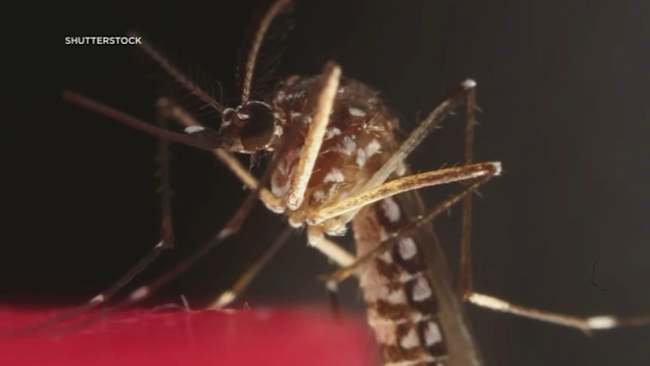
That's because milder winters and warmer temperatures can extend the mosquito season and potentially their range, allowing invasive species like Ades-Aegypti to travel further north into California. Mordecai and her team leverage massive data sets, cross-linking mosquito populations, climate shifts and disease outbreaks, to create predictive models. And she says findings in a soon-to-be-released paper suggest that climate driven forces are already at work.
"The key result that we've found is that actually a very large proportion of the existing burden of dengue, tens of millions of cases, is attributable to climate change that has already happened," she says.
Angie Nakano directs San Mateo County Mosquito and Vector control. Technicians there breed and track native Bay Area species and sometimes the new invaders as well.
"It's a lot of proactive surveillance. So that means we are out in the communities looking at potential sources of water where these mosquitoes could be breeding. We're setting traps that are targeted to detect these species of mosquitoes. And when we find them, you know, do everything we can as quick as possible to make sure they don't stick around," explains Nakano.
MORE: As mosquito-borne illnesses spread, here's how to tell West Nile, dengue and EEE apart
She says the work at Stanford is critical for predicting what strains state and county scientists should be on alert for.
"There are definitely other species of mosquitoes that have been detected in California that had not been here previously, to our knowledge," she points out.
Fellow Stanford researcher, Desiree LaBeaud, M.D., has watched the same pattern unfold on a large canvass. She often works in areas of Africa where climate change is shifting the landscape of deadly mosquito-borne diseases like Malaria.
"We know with climate change we're having increasing temperatures and also increasing extreme weather events, which include floods and droughts and all of that can actually make mosquito borne diseases. And these viruses more likely to occur because the mosquito habitat changes and extends and spreads, you know, it spreads to new areas with warming temperatures. It spreads to new altitudes with warming temperatures," says Dr. LaBeaud.
MORE: Invasive 'yellow fever mosquito' known to carry disease found in North Concord
It's why Mordecai and her colleagues continue to study both global species and those native to California. Testing factors like genetics and their ability to adapt to warmer or cooler temperatures. Uncovering clues, that could offer a roadmap, for the movements of a tiny insect some scientists describe as the world's deadliest predator.
"So this is not a future story about how climate change might increase dengue in the future. We can already attribute the fact that we have more dengue cases in the world, because the climate has already warmed and that's a really important human health impact that I think is not being considered enough. When we think about the health consequences of climate change," she argues.
The Stanford research has also revealed that some mosquito species are more adaptable to temperature changes than previous thought, hatching earlier, not growing as large, but still surviving.