Trump orders military to hold off on Iowa lead explosives detonation for now
Trump said he wants appeals court and incoming Iowa governor OK to proceed.

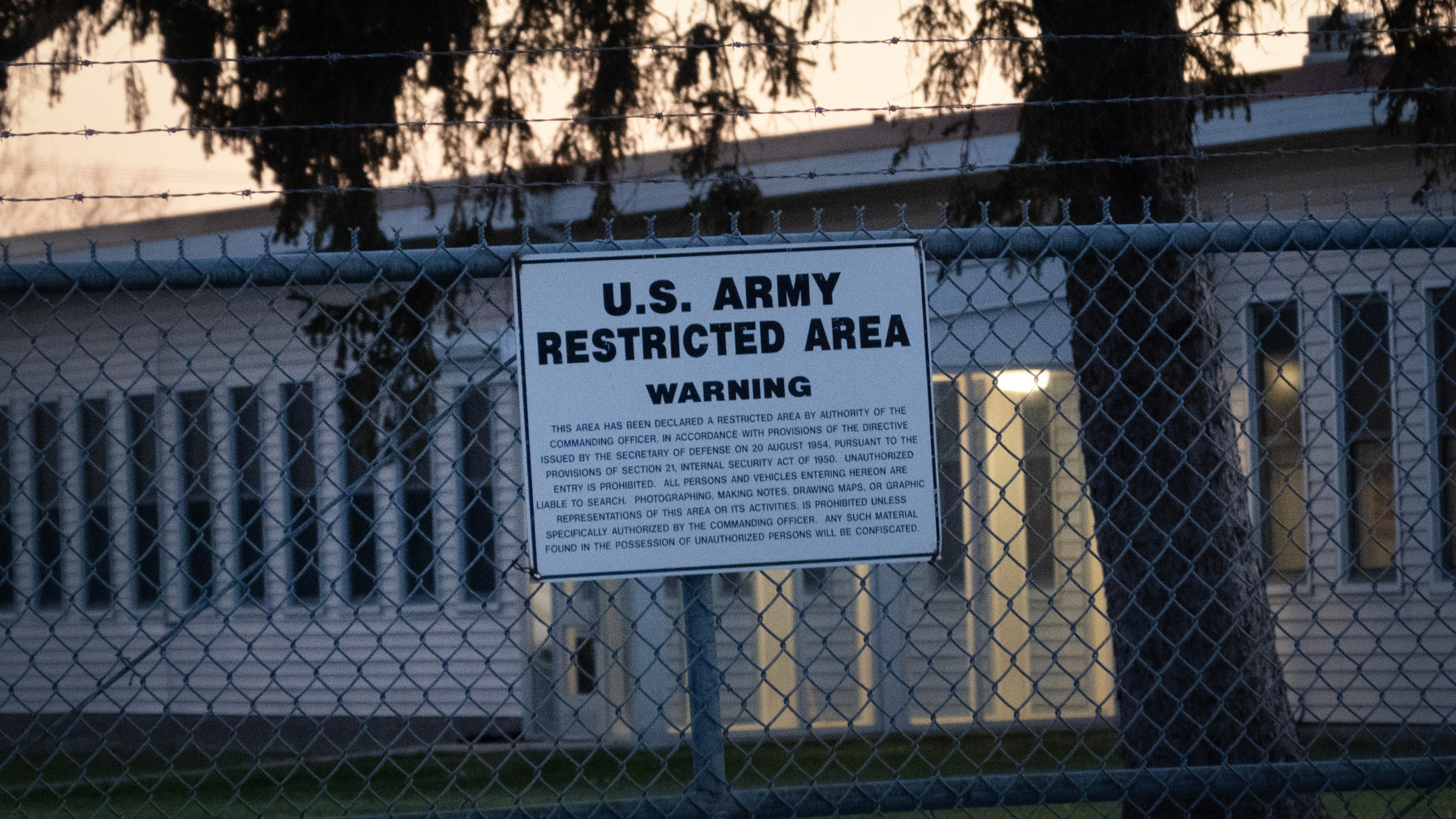
President Donald Trump said in a post on his social media platform Monday that he has ordered the military to hold off on the planned detonation of nearly five tons of lead azide at an Iowa Army plant until a federal appeals court and the incoming Iowa governor sign off on the controversial operation.
The controlled detonation of the degraded explosive material had most recently been pushed to Wednesday, amid an ongoing legal challenge to the U.S. Army's permit in the Eighth Circuit Court of Appeals.
Trump said Monday that while he believes the "proper course is to get rid of this longterm problem," he has ordered the military not to conduct the controlled detonation "until such time as the Eighth Circuit agrees that we can go forward."
He said he is "further making this decision fully subject to the incoming Governor Elect, Rob Sand, agreeing to the operation."
"If he or the Courts do not agree, we will have no choice but to not proceed with the controlled removal of these hazardous materials, and be forced to hold the incoming Governor responsible for any and all death or destruction caused by this very unfortunate, and longterm, situation," Trump said.
The controlled detonation is to dispose of degraded lead azide, which is highly sensitive to shock, friction and heat and extremely unstable. Due to the risks of accidental detonation in packing and transporting it, "safely destroying it in place is the only responsible option," the Army said.
Iowa Gov. Kim Reynolds said in a statement Sunday that while the detonation is a federal operation, the state has been "engaged in the preparation process so we can support the work of our federal partners in responding to the needs of Iowans," including evaluating potential public health impacts and providing guidance to the public.
The Army's plan to conduct a controlled detonation of nearly 10,000 pounds of lead azide at a military ammunition plant in Middletown, Iowa, has raised concerns from the public and medical groups over the potential health impacts, as well as a legal challenge from environmental groups. The Army said the detonation will cause a dust plume containing some lead, a known neurotoxin.
Sand, a Democrat and the incoming Iowa governor, previously called for transparency regarding the operation and questioned why "we are rushing to demolition."
"All relevant federal, state and local government resources should be focused on protecting everyone that could be impacted," he said in a statement Sunday. "Iowans deserve transparency over how we got here, then answers and accountability to stop this from ever happening again."
As of Monday afternoon, Sand had not publicly responded to Trump's order to pause the demolition.
Two rapid, controlled detonations were initially scheduled to take place at the Middletown plant midday Friday to safely dispose of degraded lead azide, according to the U.S. Army. Those plans were subsequently postponed twice, with the Army saying on Sunday, prior to Trump's announcement, that it had pushed the controlled detonation to Wednesday to allow for "optimal weather conditions and all mitigation measures to be emplaced."
Lead azide is the primary explosive used to detonate munitions, such as grenades and artillery shells. According to the Environmental Protection Agency, which issued the permit for the detonation, the "recrystallization of the stored lead azide has increased the material's sensitivity to friction and shock, and disturbing the containers of lead azide could create an unacceptable risk of unintentional detonation."
Top Stories


The Department of Health and Human Services, the EPA and the Army previously said the agencies are taking "extreme mitigation measuresto ensure there is no risk to the public and any disruptions are minimized."
The Iowa Environmental Council and Sierra Club Iowa Chapter filed an emergency motion on Thursday seeking to halt the detonation. The groups argued that the detonation could spread lead dust across a large area, potentially reaching communities more than 100 miles from the plant.
As of the filing, the Army's latest modeling projected that lead dust could settle across an area approximately 25 miles long and 5 miles wide, including homes and waterways, according to the motion. The groups further argued that people, livestock and wildlife could also continue to face exposures to lead once it settles into the ground.
The filing also questioned the Army and EPA's handling of public notification, alleging that some of the potentially impacted communities were not given direct or timely notice.
In an order filed late Thursday night, the Eighth Circuit Court of Appeals granted an administrative stay of the permit while the federal appeals court considered the emergency request to formally halt the detonation. That decision is still pending.
Prior to Trump's statement Monday, the Justice Department said in a court filing Sunday that the Army intended to move forward with its detonation plan, citing an "immediate risk" that those materials could "spontaneously explode."
The Justice Department also argued that the Army has the authority to move forward without that permit, saying the EPA's regulations have an exemption from permitting requirements in events that require immediate action.
The Army said it plans to detonation 68 barrels -- approximately 9,700 pounds -- of lead azide, a highly toxic and extremely sensitive explosive compound.
Lead is a neurotoxin that can cause brain damage and reduced cognitive function, particularly in children. There is no established amount of exposure that can be considered universally safe, according to the U.S. Centers for Disease Control and Prevention.
Although lead azide decomposes during detonation, the lead itself does not disappear, and lead-containing particles and residue may remain in the surrounding environment, according to Iowa Health and Human Services.
Amid the detonation plans, the American Lung Association warned that lead dust from the plume could be spread "far from site of the detonation, depending on the wind and weather," and called on the U.S. Army to work with state and local health departments and "better communicate to residentsthe expected levels of exposure,the potential health impacts and how to protect themselves."