Early 2026 NFL trends for the 49ers, Vikings, Bucs, Texans, Giants, Browns

Early in everyNFL season, you hear a lot about the pace of certain stats. But most of the time when you see that a player or team is on pace to record a certain stat, you have no idea about issues for similar things in the past.
Performance is usually going to regress toward the mean. Teams and players that started superhot will cool. Teams and players that were terrible early will get better. So we don't want to compare a team's performance after four games to what other teams have done over 16- and 17-game seasons. We want to compare that performance to what others have done in the same number of games.
We can do that with DVOA (defense-adjusted value over average) stats. We've gone back and rerun every season since 1977 to see what DVOA would have looked like as of Week 4. Here, teams are rated solely based on what they did through four games (and what opponents did over that time). And every year of DVOA is normalized so that we're comparing teams to the averages of their own era, not to what teams do in today's game.
This year, there's one team in particular playing at a historical level. You might not realize quite how good the San Francisco 49ers have been. But will their usual spate of injuries prevent them from living up to their September greatness with the franchise's sixth Super Bowl title? Let's look closer and explore three other early trends that I've noticed in the DVOA data.

1. The 49ers are the 11th-best team overall through four games since 1977 (and have the third-best passing offense)
The 49ers shocked everyone when they not only beat the favored Rams in Week 1 but destroyed them. We've sort of written off that Rams performance because of the whole jetlag issue, but maybe a part of the 49ers winning was being really good?
San Francisco has continued to win games, mostly decisively. It dominated the Dolphins in Week 2 and had a big fourth quarter to beat the Broncos in Week 4. The Niners'Week 3 victory over Arizona was 36-30, but a play-by-play breakdown suggests the 49ers outplayed the Cardinals by a much wider margin. They outgained the Cards 8.7 yards to 4.5 yards per play but had 31 fewer plays. The efficiency predicts future performance better than the raw number of plays.
Put it all together, and the 49ers are No. 1 in my DVOA ratings with a historically high number. Only 10 teams since 1977 have been higher through the first four games.
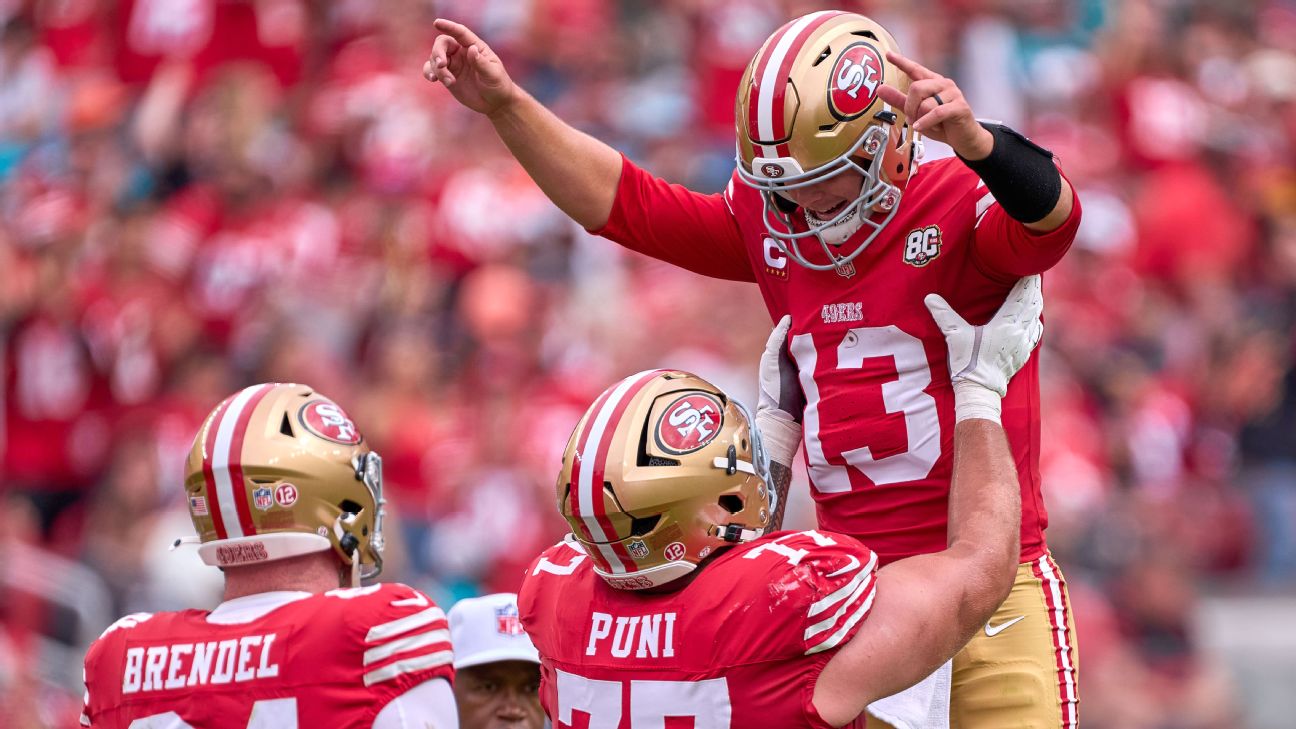
The 49ers' success is primarily being driven by their superb passing game, with quarterbackBrock Purdy leading the league in QBR. Sure, the 49ers rank fifth in defensive DVOA and ninth in run offense, but the passing game is historically good. Since 1977, the only teams with a better passing game through four games were the 1998 Broncos with John Elway and a shockingly strong 1999 Washington team with Brad Johnson at quarterback. Yes, Washington in 1999 scored 37.5 points per game over the first four weeks, while Johnson averaged 298 passing yards and 9.8 yards per attempt, nine touchdowns and zero interceptions.
That puts the current 49ers slightly ahead of some all-time great passing clubs, including the "Greatest Show on Turf" Rams, the 2013 Broncos with Peyton Manning and the 1984 Dolphins with Dan Marino.
What we can expect: Our first table shows that not every team that starts this hot is guaranteed to win the Super Bowl, but there are also some all-time great squads on that list. If we expanded it to 20 teams, we would add five more Super Bowl champions: 1977 Cowboys, 1985 Bears, 1990 Giants, 1998 Broncos and 2009 Saints. Overall, the previous 20 best teams by DVOA through four games won nine Super Bowls and lost three.
The problem for the 49ers, of course, is the injury bug. San Francisco has been among the most injured teams in the league nearly every season since coach Kyle Shanahan and GM John Lynch took over. Already this season, they've been without top edge rusher Nick Bosa(calf) and starting defensive tackle Alfred Collins(knee). Four different wide receivers are on injured reserve, and veteran Mike Evans was limited in last week's practices with a rib injury. In fact, the 49ers are running out of space on their injured reserve list.
It will be tough for the 49ers to maintain this type of all-time great performance as starters give way to backups ... who in turn give way to third-stringers.
2. TheVikings are the eighth-worst 4-0 team since 2000
Everyone saw the 49ers dominate the Rams on national television, so their 4-0 start isn't such a surprise. Kansas City is also 4-0, and most observers expected a rebound from last year's down season.
The Vikings (4-0) are the third undefeated team, but their record is perhaps a little more surprising. They can barely get any offense going. Three of their four wins came by a touchdown or less. And this week, they barely beat a Miami team that is widely considered the worst in the league.
The offense-defense split for the Vikings is remarkable. They currently rank 31st in offensive DVOA, ahead of only theChargers. They're second in defensive DVOA, barely behind only theSeahawks. And the Vikings have the benefit of this season's best special teams unit, with Myles Price leading the league in kick and punt return yardage.
Add it all together and the Vikings are 10th in total DVOA despite going undefeated. (They're even worse in ESPN's Football Power Index, ranking 14th.) That makes them the eighth-worst 4-0 team by DVOA since 2000. If we go back to 1977, the Vikings are still 13th worst out of 136 teams to start 4-0.
What we can expect: The bad news for the Vikings is that offense, in general, is more stable and predictive than defense or special teams. That means it is more likely that the Vikings offense will continue to struggle than it is that the defense and special teams will continue to be outstanding.
The good news is that plenty of teams have ridden a suspect 4-0 start all the way to the Super Bowl. It's good to bank those four wins, no matter how well you play, and a number of teams on our list improved over the course of the season. Out of the dozen worst 4-0 teams since 2000, five made the Super Bowl and two won the Lombardi Trophy.
The fact that the Vikings could go either way is emphasized by the two most similar teams on our list. The 2015 Broncos ranked first on defense and 30th on offense after four weeks. Peyton Manning never got his groove back, but the defense didn't regress and led the Broncos to a Super Bowl title. On the other hand, the Vikings are also similar to the 2012 Cardinals, who ranked 28th on offense and fifth on defense after four weeks. That team completely collapsed, constantly shuffling through backup quarterbacks after an injury to starter Kevin Kolb.

3. TheTexans andBuccaneers rank among the best 0-4 teams since 1977
The Texans were a popular Super Bowl pick out of the AFC before the season began. They are supposed to have one of the best defenses in the league and were hoping the offense would improve. Instead, the Texans have lost their first four games, three of them at home. Their season seems over.
The same appears to be true for the Buccaneers. They weren't quite as popular as the Texans in the preseason, but plenty of observers believed they could return to the top of the NFC South. They've also started 0-4 and lost three games at home.
What if I told you that the Texans and Buccaneers have actually been close to NFL average when you break down the play-by-play and look at their efficiency? Houston ranks 17th in the league and Tampa Bay ranks 18th. There are 150 teams since 1977 that have started the season either 0-4 or 0-3-1, and out of all of them, Houston and Tampa Bay rank third and fourth in DVOA.
Houston's offense has been a lot better than you think, an unexpected 13th in DVOA this season. It's the defense that has disappointed, ranking only 15th. Meanwhile, in Tampa Bay, the young defense that some folks believed could be pretty good has, in fact, been pretty good. It ranks ninth in DVOA. But the offense looks rough, ranking 24th. QuarterbackBaker Mayfield played poorly for three weeks and is now sidelined by a dislocated thumb.
Houston has been outscored by 25 points overall, but it has allowed the exact number of yards as it has gained (1,375), with the same yards per play average and a positive turnover differential. (QuarterbackC.J. Stroud hasn't thrown an interception yet.) The Buccaneers have been outgained by 18 yards, although they have a minus-5 turnover differential. All four of their losses have come by a touchdown or less.
What we can expect:Only one of the other top 0-4 teams turned things around enough to finish with a winning record. The 2004Bills finished the season with the highest DVOA of any team that has ever missed the playoffs. They fell short when they lost to the Pittsburgh backups in Week 17. But they went 9-3 over the 12 games after their 0-4 start. Other teams on the list, such as the 2011 Vikings and 1980 Jets, played down to their records for the rest of the season.
The only team to turn around a 0-4 season and make the playoffs was the 1992 Chargers. That team was not one of the best 0-4 teams by DVOA. They were legitimately bad at the start, ranking 24th out of 28 teams in DVOA, before going 11-1 for the rest of the season. Now we have 17 games in a season instead of 16, and seven playoff teams per conference instead of six, which makes it a little easier for the Texans or Buccaneers.
ESPN's FPI projections still give the Texans a 16% chance of making the playoffs. The division title will be tough with Jacksonville playing so well, but the wild-card round is a realistic goal. The FPI simulation has the Buccaneers at only 5% odds, although the NFC South might be an easier division to win. FPI has Tampa Bay much lower than DVOA, in part because it's accounting for a few more weeks with undrafted rookie Jalon Daniels starting at quarterback instead of Mayfield.

4. TheGiants andBrowns rank among the worst 3-1 teams since 2000
When the Browns got crushed 34-10 in Jacksonville in Week 1, it seemed like they were going to be the same old Browns. So it's extremely surprising that Cleveland has pulled off three one-score wins since then. The Browns have finally given life to fans who have dealt with years at the bottom of the AFC standings.
Some people thought the Giants could be this year's breakthrough turnaround team, and they beat the Cowboys 28-20 in Week 1. After a Week 2 loss to the Rams, they went on to win their next two games over Tennessee and Arizona despite losing starting quarterback Jaxson Dartfor the rest of the regular season (knee).
DVOA is not impressed. The Browns rank 23rd and the Giants are 22nd. FPI is even less impressed, with the Browns 26th and the Giants 31st. A part of the issue is that advanced stats look at every play of the season. Terrible performance in the big losses (Browns to Jaguars, Giants to Rams) overwhelms play in the three close wins for each team.
The Browns and Giants do not rank among the 10 worst 3-1 teams by DVOA since 1977, but they do rank among the worst 3-1 teams since the turn of the century.
What we can expect: The 2016 Rams collapsed from a 3-1 start to finish 4-12. But of the bad 3-1 teams, a few of them have made the playoffs, and the 2010 Bears even made it to the NFC Championship Game -- in part because they got to face a worse team, the 7-9 NFC West champion Seahawks, in the divisional round.
I think it's more likely that the Browns and Giants will play down to their DVOA over the rest of the season rather than playing better and continuing to win games. ESPN's FPI agrees. It gives the Browns an 18% chance of making the postseason, while the Giants have just a 4% chance. FPI puts a lot of weight on the quarterback's performance, and while Deshaun Watson is a surprising 18th with a 58.4 QBR, Jameis Winston is down at 28th with a 33.3 QBR.
]