Folclorico Colibri challenges traditions by allowing male dancers to perform in skirts

SAN JOSE, Calif. (KGO) -- Mexican folklorico groups are in high demand this time of year with Hispanic Heritage Month celebrations and Day of the Dead commemorations.
One of the groups that has been performing regularly is also redefining the traditional roles of folklorico dancers.
"In Mexican tradition, the male role is a dominant role and it's only represented by men. The female role is more docile," said Arturo Magaña, who founded Ensemble Folclorico Colibri.
His dance troupe is turning tradition on its head.
RELATED: National Hispanic Heritage Month begins with celebrations across the US
"Men can dance with men. Women can dance with women and we don't differentiate genders," explained Magaña.
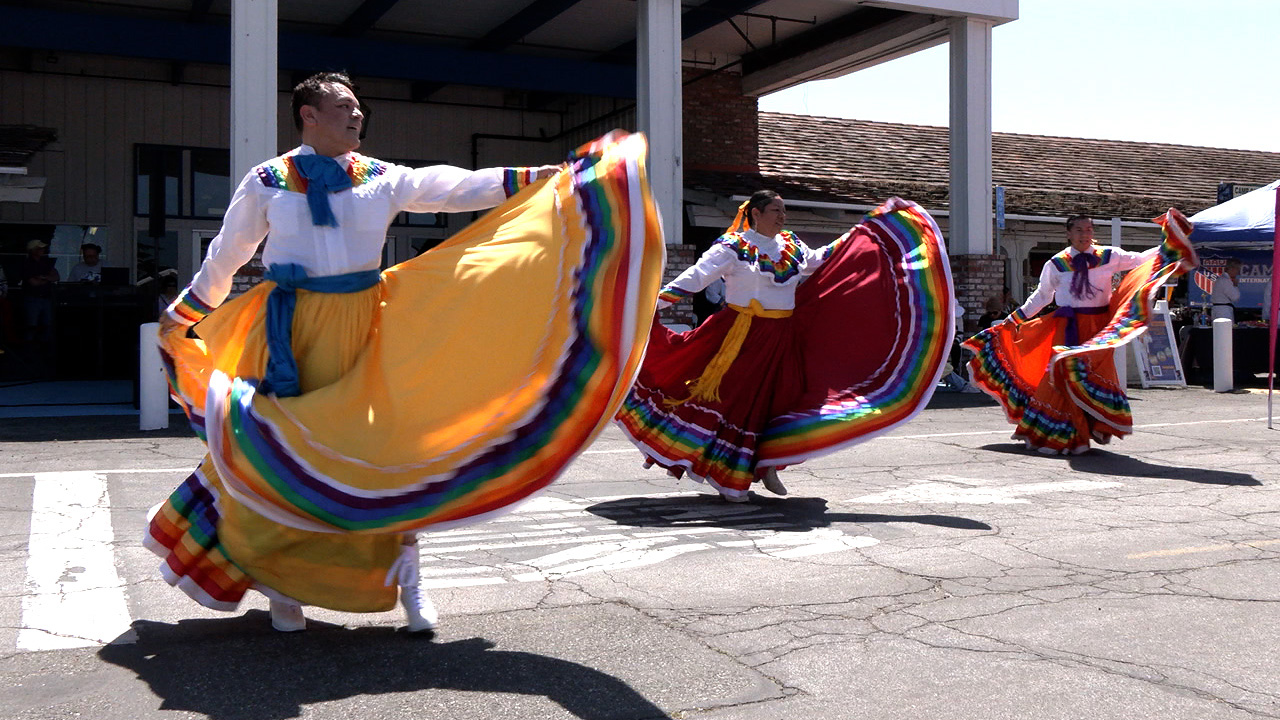
Instead, traditional female roles are called skirts and traditional male roles are called boots. Any member can dance either role.
Juan Serrano joined Folclorico Colibri after seeing them perform at a Pride event in San Jose and he saw men dancing in the colorful skirts.
"As soon as I put on my skirt and my shirt, I am a totally different person," said Serrano. "It feels amazing. It feels like I'm representing myself the way I am, the way I feel."
The dancers don't wear drag. Magaña said he does not want the dancers to feel like they are putting on a costume or playing a role.
"We decided not to do the full drag for the people that didn't want to wear makeup or didn't want to wear a wig because they didn't feel comfortable morphing into a woman in order to do the skirt work. And the same thing with the boots, a couple of our female dancers present themselves in the masculine role without drawing a mustache."
Magaña danced for years with professional folklorico groups but got pushback from traditionalists when he tried to change gender roles in those organizations.
He came up with the idea for Folclorico Colibri in 2015, founding the first LGBTQ+ presenting Mexican folkloric group in the world.
He remembers the first time the men went on stage wearing skirts at a stage performance with other folklorico groups.



"We wanted to wait and sort of have this coming out of the traditional closet," he explained.
Mia Burrell has been dancing since she was a child. She remembers wanting to dance as a charro but was told no.
"I always had to play the role of the female that was being pursued. I could never be the pursuer," recalled Burrell.
She now teaches the teen and adult classes. Burrell sees greater acceptance from the folklorico community.
"There's a whole generation out there that have been looking for this. We have people coming up to us after a performance in tears and that's so rewarding that somebody saw themselves in you on stage," said Burrell.
That's exactly why Socorro Montaño joined the group last year after seeing them perform at a Day of the Dead celebration.
"To see a group that was dancing in a queer way, they ended in a big rainbow. I was just like amazed to see that in a Mexican cultural space where unfortunately there's often homophobia or misogyny or machismo."
Montaño enjoys dancing both skirts and boots for the freedom she feels, both emotionally and physically.
"The skirts are 15 lbs. That's heavy," said Montaño. "They are doing all the work when they're doing skirt work, so in the dances where I get to be the boot, my footwork has to be clean, but my arms get a break compared to the people who are wearing the skirts."
Magaña said the group allows LGBTQ+ dancers to express their true selves.
"We just have to be fearless and get in front of people. It's not mockery. It's not an insult to our community. You have the liberty and the flexibility to represent not only yourself but also your traditions and heritage."
Folclorico Colibri's trajectory is the focus of an exhibit now on display at Queer Silicon Valley in downtown San Jose.