Oakland's homelessness crisis raises questions about crime, enforcement and housing policy

OAKLAND, Calif. (KGO) -- As Oakland grapples with a homelessness crisis that city officials say has doubled over the past decade, leaders are also confronting concerns about criminal activity associated with some encampments and questions about how aggressively the city should enforce laws while trying to provide housing and services.
Mayor Barbara Lee's administration has attributed the growth in homelessness to the region's housing crisis and widening economic inequalities. At the same time, city officials face pressure from residents concerned about public safety and property crime.
MORE: Oakland revives controversial plan to pay unhoused residents to clean areas around encampments
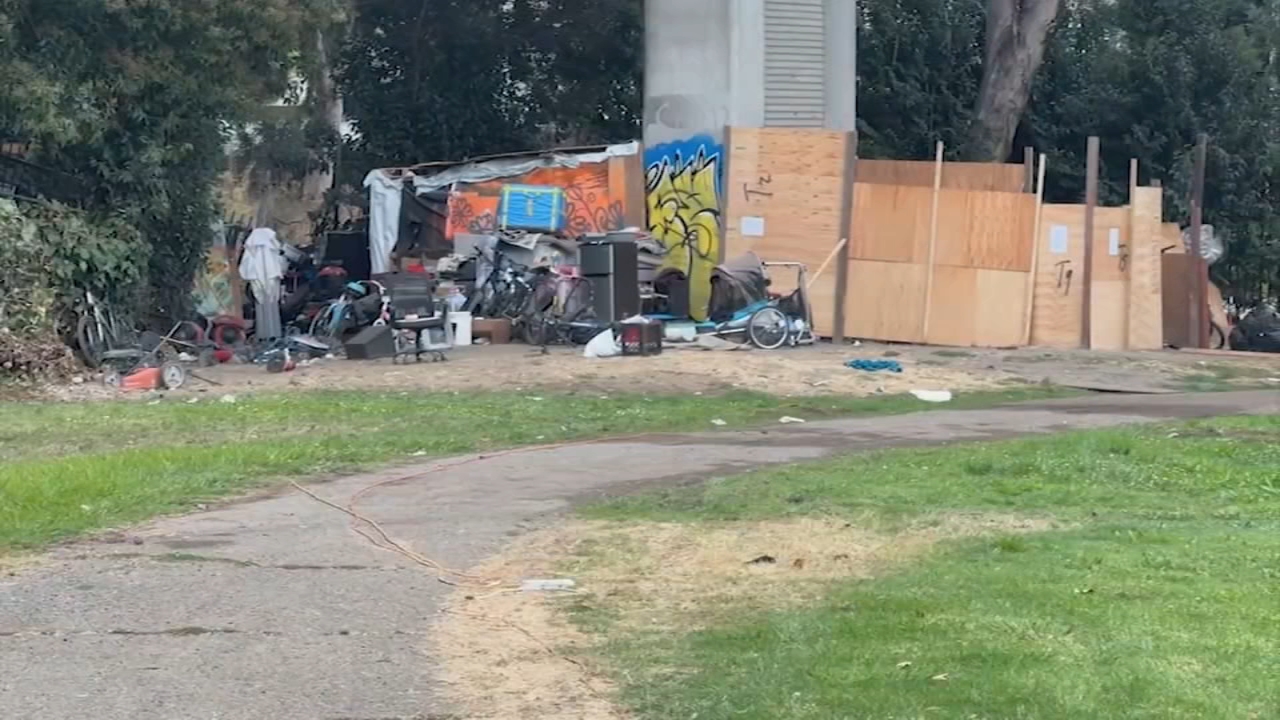
One recent example involved an e-bike stolen in Berkeley in early September. The bicycle's tracking device led ABC7 to a homeless encampment beneath the eastern edge of the MacArthur Maze in West Oakland.
The tracker guided them to a makeshift plywood structure within the encampment. Nearby were additional structures, tents, bicycles, scooters and parts. It was not possible to determine whether any of those items were stolen.
After locating the bike, reporters contacted Oakland police through both non-emergency and emergency channels. Hours later, police had not arrived. A California Highway Patrol unit that happened to be nearby confirmed the bike was inside the structure after the tracker was activated, but officers did not enter because of constitutional protections against unreasonable searches and seizures.
Nearly six hours after the initial call, Oakland police contacted ABC7 reporter Lyanne Melendez for additional information. By then, the bicycle had been recovered without active police involvement.
Oakland Police Chief James Beere acknowledged concerns about the response time but said staffing shortages and violent crime demands limit the department's ability to respond to property crimes.
"For our priority, it's violent crimes and crimes in progress. Do we need to do better when it comes to responding to calls such as that, where there is stolen property that can be recovered, absolutely. But we only have 603 officers where Measure NN says we should have 700 officers," Beere said.
He added that the department currently operates with slightly more than 500 officers available for duty.
"So with an operation strength of slightly over 500, we're going to struggle to respond to some of those calls. So our real focus is sanctity of life and crimes in progress," Beere said.
The incident highlights the broader debate surrounding Oakland's Encampment Abatement Policy, which the City Council adopted in April. The policy allows the city to clear encampments and remove vehicles used as residences while simultaneously attempting to connect occupants with housing and services.
Councilmember Ken Houston supports the policy and argues that it is helping reduce illicit activity.
"It's a bike, I understand, but it's a bike, it's not like a homicide, it's not like a burglary, it's a bike. I'm not saying it's not important," Houston said. "And it is and that's why we're abating it because that's not going to be tolerated any longer with the abatement policy."
RELATED: Oakland mayor considering major shift to encampment approach: Here's what to know
Councilmember Carroll Fife abstained from voting on the measure, arguing that enforcement efforts are limited when alternative shelter options are insufficient.
"Without proper shelter or places for people to go, it's impossible to abate anything," Fife said.
She also said criminal conduct within encampments should remain a law enforcement responsibility.


"If people are engaged in criminal activity in homeless encampments and my constituents know this, then those issues need to be address by the police department," Fife said.
Beere said police have conducted enforcement operations at encampments and made arrests involving firearms, drug trafficking and other illegal activity.
"In fact, we have made probably, you know, I would say multiple arrests related to firearms, narcotics trade, and to include casinos, so it is a problem and there are, there are, there are issues and we would like to have more resources so we could respond in kind," he said.
Some city leaders believe Oakland's policies may be attracting people displaced by enforcement efforts elsewhere.
"Clearly, every time I go out we recognize new people coming into the city from out of town because the first question I always ask them at 6 in the morning, I see them laying under the freeway and the streets, I say, hey man, where are you from? I know you're not from Oakland, Oh, I'm from Fremont, I'm from San Jose," Councilmember Noel Gallo said.
Asked why they come to Oakland, Gallo said: "Well, they feel we're allowing that to happen."
MORE: Fires, sex work, trash: Oakland parents demand action over encampments near school
Concerns about property crime also extend beyond encampments. Police reports have documented the sale of stolen goods, including bicycles and e-bikes, for decades at Oakland's Coliseum Public Market.
"They do not prioritize a stolen bikes," one bicycle advocate said.
Justin Hu-Nguyen of Bike East Bay said residents should take precautions to reduce the risk of theft.
"We live in a very dense, diverse, beautiful city but also there's a lot of different risks that we have to understand, how do we make sure we aren't a victim of a crime of opportunity," Hu-Nguyen said.
Houston said enforcement and abatement efforts are producing results in his district.
"Go to my district, district 7, you're not going to see those bikes, they're being abated and the people that are doing it know that they can't do it any longer, see that's what we have to do, it's lawlessness and we have to let them know that enough is enough and lawlessness is not tolerated," Houston said.
The debate reflects the challenges Oakland faces as it attempts to address homelessness, crime and public safety simultaneously. City leaders agree the issues are interconnected, but remain divided over whether enforcement, housing or some combination of both offers the most effective path forward.