Pay or Get Cited: Here's how SFMTA is expanding fare enforcement, awareness across Muni system
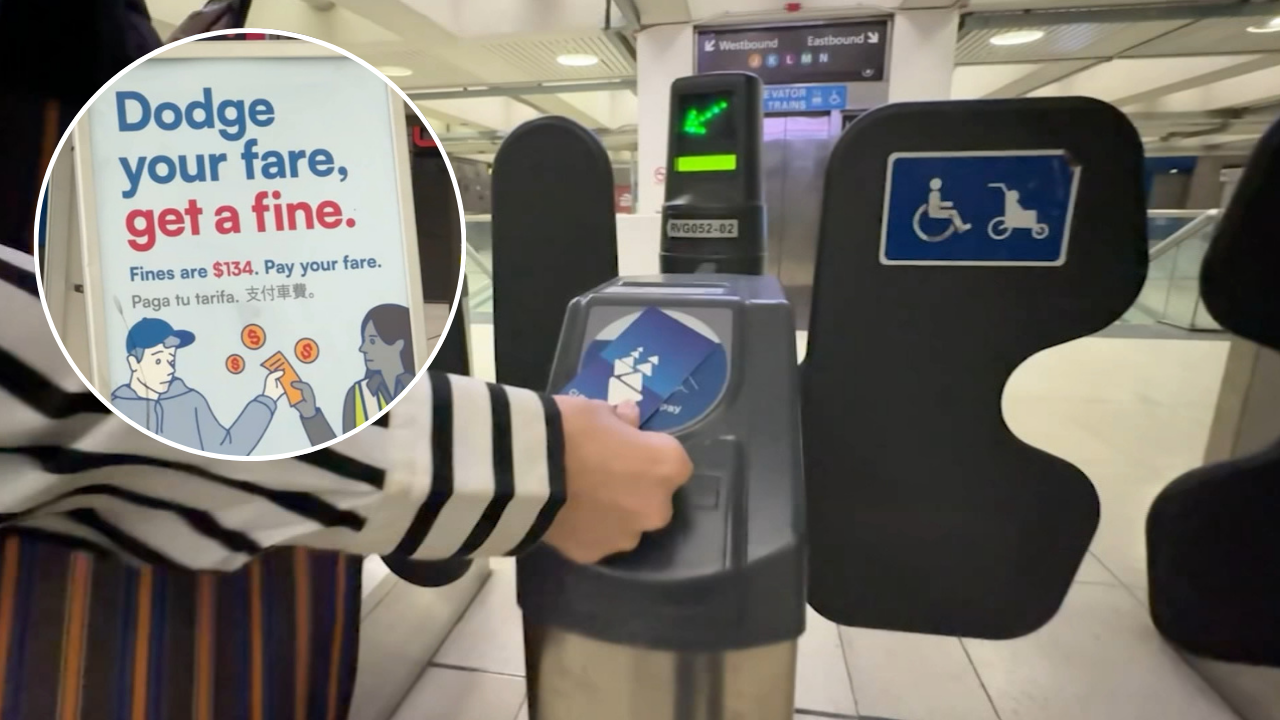


SAN FRANCISCO (KGO) -- San Francisco transit officials are increasing fare enforcement efforts across the Muni system as the San Francisco Municipal Transportation Agency faces a significant budget shortfall and seeks to boost fare compliance.
SFMTA Director of Transportation Julie Kirschbaum said the agency is still working to determine how many riders are not paying fares.
"That's something that we are currently working to better understand. There's a lot of ways to pay for Muni that don't necessarily require you to tap. And that's made it challenging," Kirschbaum said.
Kirschbaum and her team recently visited multiple stations to promote fare payment through a public awareness campaign. One advertisement uses baseball rivalry to encourage compliance.
RELATED: SF cracking down on Muni fare evasion with more enforcement, new strategies
"We know that any self-respecting San Francisco resident is not going to root for the Dodgers. So, we wanted to highlight that and say, 'Don't be a Dodger'," Kirschbaum said.
The agency is confronting one of the largest financial crises in its history, with a structural deficit of $307 million for the 2026-27 fiscal year.
As part of its enforcement efforts, SFMTA is requiring all riders to tap when boarding, a move officials say will make it easier to identify riders who have not paid.
Transit Fare Inspector G. Ng described the citation process.
"We ask them for proof of payment. If they don't have proof of payment, we would ask for their ID. So, we scan their ID if it's a driver's license, and then we'll issue them the citation," Ng said.
Some riders support measures that make paying fares more convenient.
"I love the credit card feature. It makes it a lot more convenient," rider Whitney Urbiztondo said.
Kirschbaum emphasized that several programs are available to help eligible riders reduce fare costs.
"All youth are free on Muni. We also have a regional program that people from low-income households -- that especially if you qualify for other assistance programs -- also qualify for Clipper Start. And that, makes you eligible for a 50% discount on not just Muni, but all of our regional partners," she said.
Data reviewed for the past 12 months show the number of fare citations issued has generally declined. In July 2025, Muni issued nearly twice as many citations as it did in July 2026.
Despite the decline in citations, some light rail riders said they frequently see people bypassing fare gates.
"It ruins it for everybody else," rider Warren Lee said.
Lee suggested Muni consider installing higher fare gates like those used by BART. Kirschbaum responded that the agency would like to make such improvements but lacks the necessary funding.
"That is something we'd like to do when. We don't have the capital funding," Kirschbaum said.
Kirschbaum said SFMTA currently has between 30 and 40 fare inspectors throughout the system and is hiring an additional 20 inspectors as it continues its fare enforcement efforts.
SFMTA reports sizeable increase in ridership during Outside Lands
SFMTA reported on Tuesday a sizeable increase in the number of riders using public transit during the three-day Outside Lands Music Festival weekend.

Throughout the weekend, Muni saw 1.3 million passengers trips across its system, a 7% increase in the number of travelers when compared to an average summer weekend this year.
San Francisco Mayor Daniel Lurie on social media praised the actions of the SFMTA and other city departments for their parts in planning and supporting the annual music event in Golden Gate Park. Lurie said about 75,000 people attended each day, comparable to the maximum capacity at Levi's Stadium.
RELATED: SF's Outside Lands draws thousands of festivalgoers; transit options put to the test
"There were no major disruptions throughout the weekend, thanks to the hard work and preparation from city staff, event organizers Another Planet, and volunteers," Lurie wrote on his X account. "People came together, enjoyed incredible music, and showed the very best of our city. Let's go, San Francisco!"
Leading up to the event, the SFMTA announced street closures, implemented geofenced areas that limited where ride-hailing services could operate, and plans for people and vehicles to help with the most crowded areas during peak travel times.
Concerns about the influx in crowds and the impact to transportation arose following the Fourth of July fireworks show at the Golden Gate Bridge that caused cars and buses to spend hours in gridlock traffic. This year's Outside Lands festival saw large crowds, but with no reports of major delays that were out of the ordinary for the annual event.
RELATED: SF Mayor Daniel Lurie says transit issues 'unacceptable' after July 4th traffic fiasco
Three of the busiest lines were the 5-Fulton, 5R-Fulton Rapid, and N-Judah. Between Friday and Sunday of the festival weekend, roughly 160,400 trips were made on these three routes, which equates to a 13% increase when compared to last year.
Erica Kato, a spokesperson with the SFMTA, said the agency gained practice in planning and executing an efficient system for the music festival after so many years. She said those with tickets and wristbands could ride public transit for free across the system.
"We're a well-oiled machine when it comes to getting those buses, the shuttles, out there," said Kato. "We had extra field inspectors out there making sure that trains were moving and people were getting on board."
Posts on social media showed long lines for full buses and trains. Others complained about the price-surging for ride-hailing services.
Kato said the agency will do what it does every year, an in-depth analysis of the successes and challenges associated with providing transportation for Outside Lands.
"So, along with our inspectors and our communication ambassadors, we're really proud of the success this year, and we can't wait for next."
Bay City News contributed to this report.