San Francisco to open RESET Center as mayor shifts drug policy toward enforcement, treatment
Facility will start getting its first clients on Monday, May 4.

SAN FRANCISCO (KGO) -- A year after San Francisco Mayor Daniel Lurie shifted the city away from its long-standing "harm reduction" strategy toward what he calls a tougher, intervention-focused approach, the city is preparing to open a new facility intended to disrupt open-air drug markets and steer people into treatment.
The Rapid Enforcement Support Evaluation and Triage Center, known as the RESET Center, is designed as an alternative to jail or the emergency room for people arrested for using drugs or alcohol on city streets. The pilot program is set to open Monday.
RELATED: How people in SF's Tenderloin perceive reported progress in drug and homelessness issues
Lurie signed legislation last February to open the new Rapid Enforcement Support Evaluation and Triage Center better known as the RESET Center.
The center occupies a former graffiti-covered building near the Hall of Justice that has been converted into what city officials describe as a sobering center. People arrested for public intoxication - a crime under California law - will be taken there rather than booked into jail or transported to a hospital, according to officials. Lurie said the goal is not punishment but recovery.
"The goal is to get them into recovery, the goal is to give them the treatment they need," he said.
During a tour of the facility, city officials and supporters of the program outlined how the center will operate.
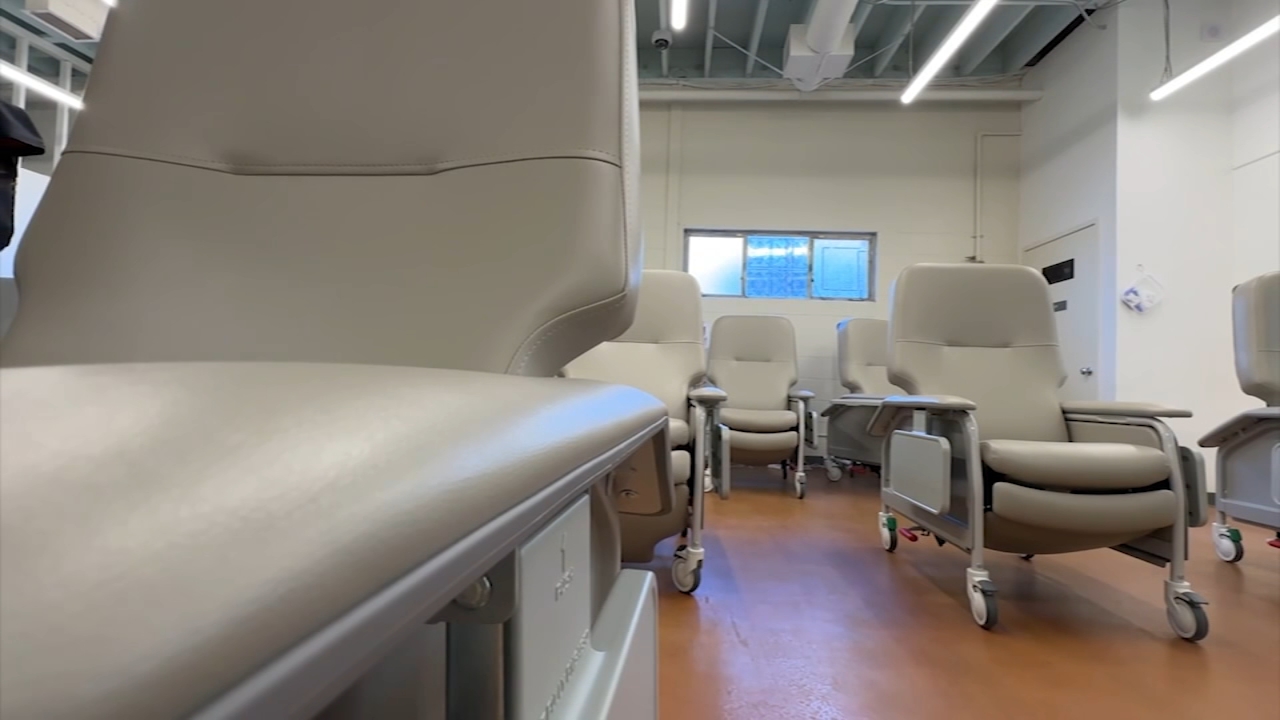
Law enforcement officers will arrest people for drug or alcohol use on the street, many of whom officials say are unable to care for themselves. After being processed, individuals will be allowed to rest in one of 25 so-called "therapy recliners."
They can be held at the center for four to eight hours to stabilize before being offered access to treatment and services.
"The further we can extend that time, the better chance we have," said Colin LeClair, the CEO of Connections Health Solutions when asked about the length of stays at the center. Pressed on whether a longer period than eight hours would be preferable, the official added, "If we can, if we can, the more time, the better."
MORE: San Francisco eyes new strategy to put an end to drug markets: Here's what we know
The official said longer stays are not guaranteed because the program is voluntary. "Because it's voluntary, they are allowed to leave." Connections Health Solutions, is a crisis care company that operates similar facilities in five other states.
The San Francisco Sheriff's Office and the Department of Public Health will oversee the program.
"There will be 24/7 nursing care, there will be social worker access, there will be peer support meaning people with lived experiences helping to motivate and work with individuals here to connect to treatment and services," said Daniel Tsai of the San Francisco Department of Public Health.


City officials acknowledge concerns that the demand for treatment could exceed available capacity, an issue that has long challenged San Francisco. Another obstacle, supporters say, is reluctance among some users to stop using drugs.
"I don't know. I don't think I want to stop using drugs. That's the problem," one man said. Some critics argue that without meaningful consequences, people are less likely to pursue recovery.
Supervisor Matt Dorsey, who has spoken publicly about his own experience with addiction, said accountability can be a crucial turning point.
"I don't know anybody in recovery who has had success in it who can't point to some consequence," Dorsey said. "But it's usually consequences that save lives."
Sheriff Paul Miyamoto said repeated encounters with the justice system can influence behavior change.
MORE: SF says no more distribution of 'harm reduction kits' without option for treatment
"In my experience when people keep coming to jail at one point they come to a subjective realization that hey, maybe I should move on from this cycle and that's what we're trying to do, break that cycle," he said.
At least two members of the Board of Supervisors and the Coalition on Homelessness have criticized the RESET Center, raising concerns that it functions as a detention facility - a characterization Lurie disputes.
Pressed on how he would describe the center if not as detention, Lurie responded, "It is a reset. It's a reset, that's our one word."
Even LeClair acknowledged that it is not expected to work in every case.
"For those who are involuntary and stay involuntary, yes," he said when asked whether people agree to treatment because they feel obligated.
Asked if some return again and again to the center, he added, "Oh yeah, absolutely, 100 percent recovery is not the goal. That's an aspiration that will never be reached."
Lurie has acknowledged the program will not be foolproof, but he and supporters say the RESET Center represents a new attempt to interrupt cycles of addiction, incarceration and hospitalization on San Francisco's streets.