US-Iran update: Trump says deal to reopen Strait of Hormuz could come as early as Wednesday
There are growing concerns about American stockpiles of air-defense missiles.

CAIRO -- U.S. President Donald Trump said a deal to reopen the Strait of Hormuz could come as early as Wednesday, as Iran and Oman inched toward an agreement on the critical waterway that could ease pressure on the global economy and potentially help bring an end to the war.
The U.S., along with Israel, launched the war on Feb. 28, citing various goals including toppling Tehran's government and ending its nuclear program. But the conflict has devolved into a fight over the strait as Iranian threats and attacks on shipping ground traffic through the waterway to a halt.
SEE ALSO: NJ water utilities hit by cyberattacks with suspected link to Iran
Closure of the strait, through which a fifth of the world's oil and natural gas once passed, has driven up the price of fuel and basic goods far beyond the region, roiling the global economy. Trump is also under mounting pressure to end an unpopular war ahead of midterm congressional elections.
Trump says a deal to reopen the strait is close
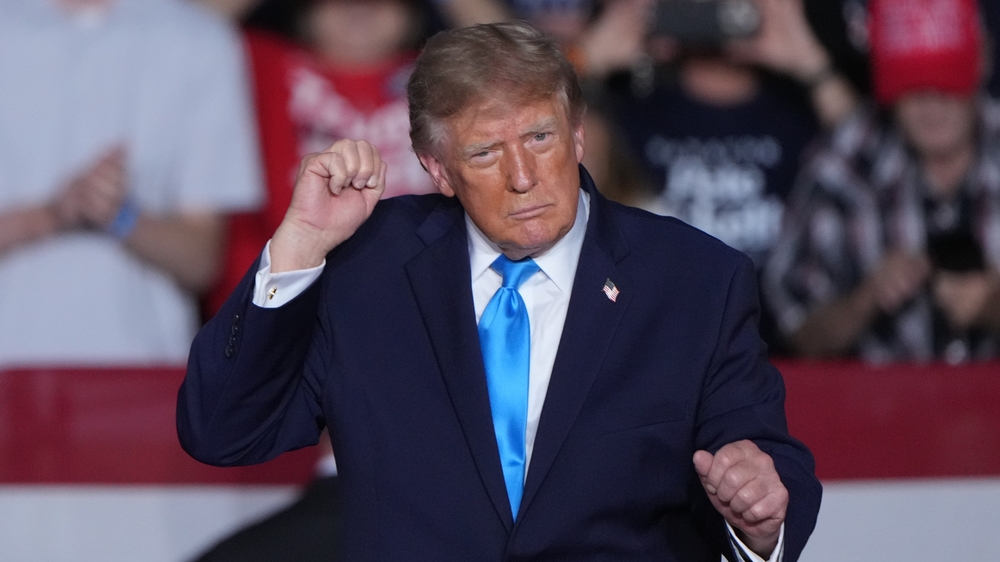
The U.S. president was asked by reporters traveling with him in California about a report on the Axios news site that an announcement on the Strait of Hormuz could be made on Wednesday.
"It could happen. Tomorrow or the next day," he said, speaking Tuesday evening California time. "A lot of progress has been made."
Oil prices initially eased on hopes of a deal that would allow shipping to resume but later inched upward. Brent crude, the international standard, was around $80 per barrel on Wednesday - still well below the levels it hit at the height of the conflict.
The U.S. and Iran reached a deal to open the strait in June, only for attacks to resume. In recent days, Trump has again alternately threatened massive strikes and voiced support for diplomatic efforts.
Regional officials tell AP negotiators have finalized a draft of a deal
Iranian and Omani negotiators have finalized the draft deal to reopen the Strait of Hormuz and are awaiting a final approval from Iran's supreme leader, two regional officials told The Associated Press on Wednesday.
The officials, who were briefed on the negotiations, portrayed the potential deal as a temporary solution to the U.S.-Iranian dispute over vessels' transit through the Strait of Hormuz. They said it is tied to the agreement reached between the U.S. and Iran in June that aimed at ending the fighting and reopening the Strait of Hormuz, but which ultimately collapsed.
The officials, who spoke on condition of anonymity to discuss the matter, said the potential deal will pave the way for the U.S. and Iran to resume negotiations to reach a final deal on Tehran's nuclear program.
Earlier, they had said the possible agreement between Iran and Oman calls for ships to enter the Persian Gulf through an Iranian-controlled route and exit through a route controlled by Oman. Service fees would be charged for providing security and preserving the maritime environment, the officials said.
Oman has not officially commented.
Iran's Foreign Ministry spokesman, Esmail Baghaei, said that the agreement with Oman is in the "final stage" of drafting, and that a joint statement will be issued "if certain parties do not obstruct this process," apparently referring to the United States.
The Trump administration has previously ruled out any deal that would give Iran control over the strait, which was an open international waterway before the war, but has seen traffic reduced to a trickle.
Attacks on shipping continue
Even as hopes increased that a deal on the Strait of Hormuz could be imminent, attacks on shipping in the region continued.



The Iranian-backed Houthi rebels claimed Wednesday they had fired ballistic missiles toward a Saudi oil tanker called the Wafa in the Red Sea. Brig. Gen. Yahya Saree, a military spokesman for the Houthis, said in a prerecorded statement that the vessel was targeted off the Saudi port city of Yanbu. He didn't provide evidence.
There was no immediate comment from Saudi Arabia.
The attack is part of a recent escalation between the rebels and Saudi Arabia that threatened to reignite Yemen's civil war, which pitted the Houthis against a Saudi-led coalition supporting the country's government.
In July, the Houthis announced they were closing the Bab el-Mandeb Strait that leads to the Red Sea for Saudi-linked shipping. That puts additional pressure on international shipping since the Red Sea became a key alternative route for Saudi oil exports during the war.
On Tuesday, an Indian-flagged commercial ship sank in the Red Sea off Yemen after being struck by an explosive-laden boat, Yemeni and Indian authorities said. Yemen's coast guard rescued the crew, which included 13 Indians and a Yemeni. There was no immediate claim of responsibility.
Israel and Hezbollah's ceasefire increasingly shaky
Meanwhile, the already shaky ceasefire between Israel and Iran-backed Lebanese militant group Hezbollah grew more volatile Wednesday, as the Israeli military issued an evacuation warning to residents of the southern Lebanese village of Mansouri - the first such warning in weeks. Israel said that it was in response to Hezbollah's violation of the ceasefire agreement between them, which had largely held since June 20.
In a post on X in Arabic, Israeli military spokesperson Lt. Col. Ella Waweya told residents to evacuate their homes immediately and move at least 1,000 meters north of the village. Later, the Israeli military said it had begun conducting "precise strikes" in southern Lebanon in response to what it described as "a blatant violation of the ceasefire" by Hezbollah.
The escalation came as Lebanese and Israeli negotiators met in Rome for a second day to discuss implementation of a deal under which Israeli forces are supposed to withdraw from areas they are occupying in southern Lebanon in exchange for disarmament of Hezbollah.
There are growing concerns about American stockpiles of air-defense missiles.
"Sources tell ABC News that after months of war, U.S. stocks of air defense missiles have been significantly depleted: a major concern if this conflict were to escalate once again," Matt Rivers said.
Reuters reports the Pentagon has drained "virtually all" its supply of long-range precision missiles and nearly half its Tomahawks.
The White House has insisted the military will have what it needs.
Becatoros reported from Athens, Greece, and Superville from Rancho Palos Verdes, California. Aamer Madhani, Fatima Hussein and Matthew Lee in Washington and ABC News also contributed.