Venezuela earthquakes death toll rises to at least 1,430 as desperation mounts
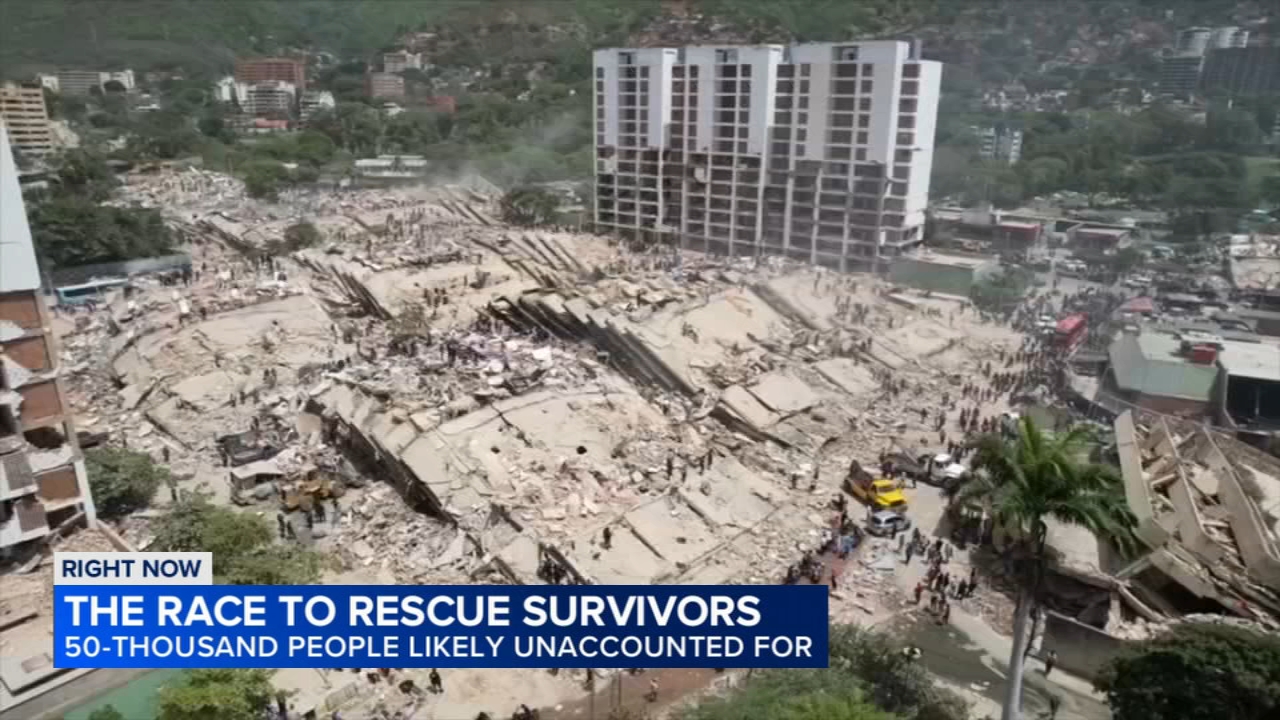

LA GUAIRA, Venezuela -- Tensions flared Saturday as desperation grew in Venezuela's state of La Guaira as rescuers and civilians searched for earthquake survivors and the death toll rose sharply to 1,430.
Families reported at least 68,900 people missing Saturday, three days after the one-two punch of 7.2 and 7.5 magnitude earthquakes devastated the South American nation.
Venezuelans looking for loved ones and neighbors used shovels, heavy equipment, ropes and bare hands atop mounds of toppled concrete throughout La Guaira, one of the hardest-hit states. They were joined by a growing number of international rescue teams who began to climb through the rubble, offering a small glint of hope to anguished families.
Tensions peaked over what many Venezuelans viewed as an inadequate response by the government, whose soldiers, firefighters, police and military cadets were evidently underprepared to respond to the scope of the tragedy. Frustration was amplified by efforts to project the image of a robust state response.
Aid agencies consider the first 48 to 72 hours as crucial for retrieving people alive, though that can be extended if they have access to food and water. Venezuelan officials said 17 flights carrying more than 1,600 rescue team members had touched down by Saturday.
As 72 hours passed since the earthquakes struck, many felt every minute ticking away as they ran out of time to rescue people alive.
"There's a pile of bodies over there from last night. Newborn babies," said Mileidy Romero, who was among those searching in the seaside town of Caraballeada. "At 8 p.m. (yesterday) there were people alive down there, and they haven't bothered to rescue them. We've located several bodies, and they haven't helped us recover them either. What are they waiting for?"
SEE ALSO: How to help victims of deadly Venezuela earthquakes
Tension mounts during rescue efforts
Acting President Delcy Rodríguez said on state television that more than 14,000 members of the military and police are patrolling the area, where access is now blocked and special permits are required to enter. But many in disaster zones said they had seen little of their government.
Some people climbed the remnants of buildings and cried out names, hoping for any proof of life. Dust coated coastal communities. In punishing heat, more people wore masks as the stench of decomposition spread. In other parts of La Guaira, teams loaded stacks of bodies - some in white bags, other naked - onto white trucks from the ground of a dirt hospital parking lot, where they were being identified.
Without hard hats or other gear, rescuers and civilians instead wore motorcycle helmets as they searched piles of debris that were once people's belongings: Eddie Murphy and Nemo DVDs, a kitchen sink, mattresses and shoes.
Some, frustrated by the government's response, blocked an excavator from leaving the site of a collapse and pulled the operator from its cabin shortly after state workers took selfies in front of flattened buildings and left without helping. The ruling party's officials often take selfies to show participation in government-related events.
A few feet away, at least five bodies wrapped in blankets.
A member of the crowd, Yeison Marcano, said those searching had received some assistance from an investigations unit but neither police nor the National Guard helped.
"They came to eat arepas and take pictures to make it look like they were working," Marcano said. "They didn't even get their uniforms dirty like we have. We've been here for three days."
A minute later, a man tried to grab a firefighter, shouting and cursing. "Silence! Silence!" rescuers shouted as they tried to confirm whether someone was trapped alive.
Meanwhile, an older man was pulled from the rubble of a public housing building. Visibly disoriented, he begged a nurse for water. He fought with personnel who put him into a pickup truck, screaming, "My family! My family!"
Searches mix with uncertainty
The International Organization for Migration said over 6 million people could be affected, some 2 million in the capital, Caracas, alone.
Experts said the destruction was amplified by the quick succession of shallow quakes. For days, smaller aftershocks occasionally shook the capital, Caracas and areas hit by the quakes, including one measuring 4.8 on Saturday.
The disaster poses a huge challenge for Rodríguez, the former vice president who took office in January after the U.S. capture and removal of then-President Nicolás Maduro. Venezuela has been facing economic disarray for more than a decade, and many people reject the legitimacy of the political movement Rodríguez represents.
Search teams and foreign aid continued to arrive from Mexico, the U.S., Brazil, El Salvador, France and elsewhere.
On Saturday, Mexican rescue teams climbed over collapsed buildings and pushed their heads into holes in the pancaked concrete to search for signs of life, occasionally hearing movement.
"We're rescuers from the Mexican military, if there's anyone down there still alive, make noise or scream. Now!" one man shouted.
A glimmer of hope
For many, the images of international aid teams arriving and climbing through the rubble alongside them offered a glimmer of hope. Yonahí Regalado has been calling out the names of her sister and 1-year-old nephew and godson since 1 a.m. the day after the earthquakes until aid workers began to arrive.
"It doesn't matter who it is, whoever, whether it's family or somebody else. If there is anyone alive, let's get them out," she said, as helicopters circled overhead.
Small moments of humanity mixed with grief and terror.
Rescue teams carefully handed down a 18-day-old swaddled in pink blankets from a building after 12 hours of searching for the baby boy and his mother, Telemundo reported. One 69-year-old woman, saved by Salvadoran teams, asked for a Coca-Cola upon being pulled out of the rubble, Salvadoran authorities said.
One video showed a Venezuelan rescuer comforting an elderly woman trapped beneath the rubble, scared that the structure would cave in if she moved.
"The roof won't cave in. If it falls, I'll be here with you," he said.
Simón Bolívar International Airport, which serves Caracas, was badly damaged. One runway was operational as U.S. teams worked to repair the crucial throughway, Jeremy Lewin, a senior State Department official in charge of foreign assistance, told reporters.
Lewin said a U.S. Navy transport ship was docked off the coast, ready to receive airlifted survivors in need of medical attention. Lewin said it is a "race against the clock" to find people injured in the quakes.