'We're in this to build something': Why there's renewed optimism for Cal football

BERKELEY, Calif. -- UC Berkeley chancellor Rich Lyons was about 12 when he started visiting one of his older brothers on campus. His parents hadn't gone to college, but when his brother enrolled, those trips provided him an early window into a brand-new world.
An important part of that introduction came through football. He would come for the game, spend time with his brother and find himself fascinated by the larger university community.
"If I can be honest with you," Lyons said, "I think part of it was my brother was in a fraternity. So, when I'd come to the game, we'd often gather there. And it's sort of like, 'Huh, that looks interesting.'"
Without the home games, though, his visits to his brother might not have left him as enamored with the school and, perhaps, he might have sought out a different place for his own college experience when the time came.
"I think it's the whole thing," Lyons said. "The academic part of it really was part of it. It was like this brother of mine's going to this best public university in the country, and there's all this other stuff going on. The whole package just kind of blew me away."
Lyons graduated from Berkeley in 1982, achieved a doctorate in economics from MIT and returned to Berkeley in 1993 to join the Haas School of Business faculty, eventually spending a decade as dean. Through it all, his Calfootball fandom endured, despite the team's decades of mediocrity.
Cal's last outright conference title came in 1958. It's a remarkable drought that has come despite a steady flow of NFL talent, 12 head coaches and an otherwise successful athletic department. Throughout the old Pac-12, programs with less inherent advantages managed to accomplish considerably more.
There isn't one way to explain Cal's prolonged lack of success in football, but any attempt to do so always circles back to the same place: the top of the org chart. It's a common belief among just about anyone who pays any attention to Cal football that the ones who previously led the university had not cared enough about football to make the institutional commitment required to compete at the highest levels of the sport.
So, when Lyons became the first Cal undergraduate to be named chancellor in 2024, there was immediate hope that the dynamic would change.
"When the chancellor was hired here, I was on a bunch of text threads with ex-Cal Bears like myself, just with former teammates, there was an excitement of, 'Man, we might have someone here that gets it and supports the football team, supports the athletics and might be a change in guard here,'" new Cal coach Tosh Lupoi said.
A year later, Lyons hired former Cal linebacker and two-time NFL Coach of the Year Ron Rivera as the football general manager. Then came Lupoi, and for the first time, the three most influential figures shaping the direction of Cal football -- the chancellor, general manager and head coach -- are all Berkeley graduates.
"I don't think there's any secret that there had been just some disconnect from the athletic program or the athletic administration and central campus," Lupoi said. "For any successful operation, I think it's really important for those to be aligned and to be connected."
An uptick in optimism from the hire of a new coach is expected -- and Lupoi's arrival has certainly done that -- but what's different in Berkeley this time for Old Blues is that, for maybe the first time, there is a growing sentiment the football team might actually have become a university priority.
A BLUE-AND-GOLDversion of the San Francisco skyline covers nearly an entire wall of Lupoi's office. The buildings are labeled: Apple, Tesla, Google, Salesforce, eBay, Levi's, Intel and EA Sports, among others.
Lupoi had the mural installed shortly after being named the head coach at his alma mater. Each label, he said, identifies a company with a Cal graduate serving as a founder, president, CEO or co-CEO. For a recruit sitting on the leather couch beneath the display, it illustrates what a Berkeley degree might unlock after football. To the players already in the program, it represents potential NIL partnerships and access to one of the world's most valuable professional networks.
But the mural is also a map of the people Lupoi believes Cal football needs right now.
"There's 44 Fortune 500 companies across the bridge that exist here," Lupoi said. "A lot of those are Cal grads that kind of dominate that market."
Lupoi sees the mural as evidence that Cal's problem has never been a lack of potential benefactors. The challenge has been turning the extraordinary wealth into support for football.
Several multimillionaires and a few billionaires have visited the football facility, he said. They've observed practices and meetings and sat on the couch underneath the skyline. Those meetings, at least in part, have been educational. Here is how college football works now in the NIL era; here is how you can make a difference; here is why that matters.
After being hired as the defensive line coach at Cal in 2008, Lupoi quickly gained a reputation as one of the best recruiters in college football. He spent four seasons on Jeff Tedford's staff before an abrupt departure forWashingtonto join Steve Sarkisian's staff in Seattle. From there, he found his way to Nick Saban's staff at Alabama, rising to defensive coordinator. After three years coaching in the NFL (Cleveland Browns, Atlanta Falcons, Jacksonville Jaguars) from 2019 to '21, Lupoi returned to college football as the defensive coordinator for Dan Lanning at Oregon, where he spent the past four years.
He saw firsthand the type of support needed -- institutionally and from donors -- to compete at the highest level of the sport. He said he believes Cal has the financial capacity to compete differently, if it can activate enough of its alumni base.
"The SEC dynamics is where there's typically that one or maybe two big-dog donors," he said. "Cal, we have 15 billionaires, for example, that are all Cal grads, and potentially more."
The challenge, he said, is getting them to understand how contributing to football can have a broader impact than what shows up in the standings. It's one thing for Lupoi or Rivera -- the football guys -- to recruit high-net-worth donors, often types who haven't shown much interest in athletics in the past. It's different when the same pitch comes from the university chancellor, who just happens to be an expert economist.
"I'm right at their side when it's time for somebody who wants to talk about a transformative gift," Lyons said. "I think a lot of those alums want to know that, not that they feel that athletics needs help, but I think for a lot of them, it's like, 'Yeah, I want to advance the mission this way.' And that's kind of a uniquely chancellorial story."
Last month, Cal athletics announced it received $88.5 million in gifts and pledges during the 2025-26 fiscal year, including 18 commitments of at least $1 million. That total was up from a record $82 million the year before, which came after a significant jump from $39 million in 2023-24.
With the increase in donations has also come an increase in football operating budget. In fiscal year 2022-23, the program's operating budget was approximately $33 million -- a number that included all costs needed to run the program, aside from NIL. This year, the program's budget is up to $71 million.
Cal is doing this despite taking a financial hit from the collapse of the Pac-12.
Joining the ACC preserved Cal's place in one of college sports' four major conferences, but it came at a price. As part of the agreement to join in 2024, Cal agreed to receive just 30% of a full ACC media-rights share for its first seven years in the conference before that percentage begins to increase.
"It's only a wake-up call if you paid attention to it," Rivera said. "We have to earn it every year. We go out and raise it."
The increased donations are an encouraging trend, but at this point, that's all it is.
Lyons is under no illusion that the increased spending will guarantee anything.
"There are some things in economics, like if you make this investment, you will get that return," Lyons said. "And then there are other investments where it's like, here's an investment that you got a higher expected return, but there's a lot more variance. There's a lot more volatility. Well, investing in athletics is kind of the latter."
Across college football, there is no shortage of schools that have spent aggressively without getting the results they envisioned. Lyons said Cal's commitment is not contingent on an immediate payoff.
"We're not making a one-year bet," he said. "We're in this to build something."
And there are limits to what Berkeley is willing to compromise in pursuit of success. Lyons said the football program has to operate in a way that remains consistent with the university's academic standards and values. But those qualifications do not lessen the expectation attached to the investment.
"We want to win," Lyons said. "We need to win."
AFTER WINNING THE starting job as a true freshman last season, quarterback Jaron-Keawe Sagapolutele needed only a few series to show the country -- or at least anyone who was watching -- he was a rare talent. It would have been easy to watch him play and wonder if he would eventually become the No. 1 pick in the NFL draft.
Cal fans had seen a similar debut not too long ago. Jared Goff debuted his potential for a downtrodden Bears team in 2013, three years before he was the draft's first pick. But that was a different era. With Goff, there was a comfortable expectation he would see out his career in Berkeley before the pros came calling.
With Sagapolutele, his emergence resulted in an inevitable question: Will he stay at Cal beyond this season?
That speculation never fully went away, lingering through the season and intensifying after coach Justin Wilcox was fired on Nov. 23, with a game left in the regular season. Sagapolutele said his agent told him other schools were trying to reach him, though he instructed him not to tell him which ones while Cal was still playing.
After Lupoi was introduced as Cal's head coach on Dec. 5, he diverted from his initial itinerary for the rest of the day and booked a flight to Hawai'i. Sagapolutele was home on Oahu and Lupoi's top priority was to retain the budding superstar. He wanted their first interaction since becoming the head coach to be in person.
"It made me feel like I was a big part in need of this team," Sagapolutele said. "Ultimately, what he pitched was really what he's been doing this whole time -- and he's exceeded expectations in a short amount of time that he's been here. I'm just so grateful to have him."
With Lupoi, everything revolves around recruiting. That's what stood out immediately to assistant general manager Marshall Cherrington.
"Anytime Tosh is trying to hire someone, it's how can you help with talent acquisition?" Cherrington said. "Whether that be, 'Hey, you can communicate really well with the recruits, or you're a really good evaluator, or you're really smart in terms of setting up deals for these players off the field. How can you help with talent acquisition?'"
Prioritizing recruiting -- or talent acquisition -- is a common refrain in college football, of course, but the follow-through doesn't always support the lip service.
"I've been at places that have said that in the past. They might have said it, but their actions didn't follow that," Cherrington said. "His actions follow it every single day. Doesn't matter what hour of the day it is, too. 1 a.m., 2 a.m., that phone could be buzzing. And it really has no limits to it.
"It's been just completely different than anything I've experienced here in the past. We have more access to talent than we've ever had before because of the person he is and because of some of the players here and their draw."
Sagapolutele's return was a major boost for the whole offseason. The Bears had ESPN's No. 19-ranked transfer class, as they tried to load up on receivers to give Sagapolutele a more dangerous group to work with.
For a program that hasn't finished above .500 in conference play since 2009, encouraging developments like these can be celebrated, but optimism can have a short shelf life if the results don't follow.
RIVERA HAS ENCOUNTERED that skepticism in conversations with donors. Some have bought into the changes immediately. Others, worn down by what has happened since the end of the Tedford era, have been more reluctant.
"We have a lot of show-me-first people, which I respect," Rivera said.
He understands the sentiment. Better recruiting classes, more NIL money and record fundraising are meaningful only if they eventually produce a better football team.
"If we can do all three of those things this season with Tosh as our head coach, that takes us to another level," Rivera said.
Lyons doesn't need much convincing to show up.
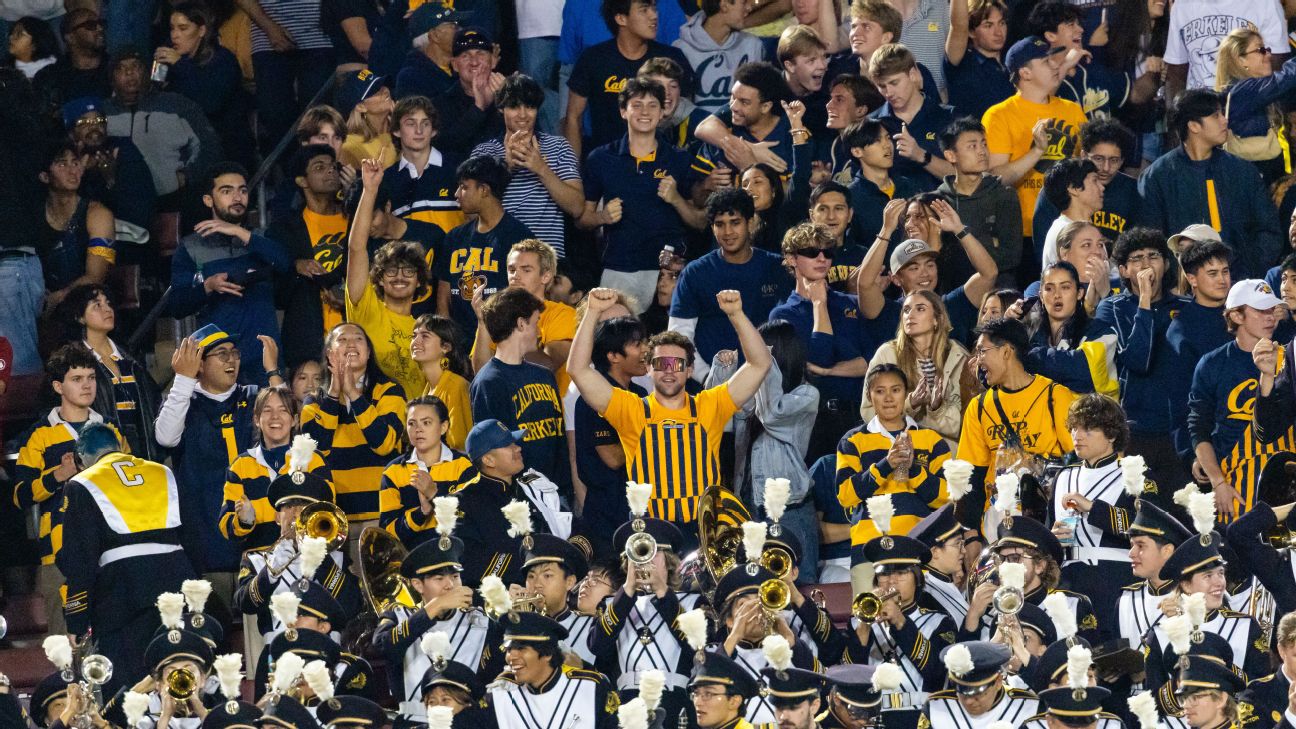
During home games, usually sometime in the third quarter, Lyons makes his way down to the front row of the student section. He high-fives students and tries to lead at least one cheer.
"You could say, 'Well, that's kind of a little bit cheesy or whatever,'" Lyons said. "It's a thrill. It's just a thrill."
He wasn't much younger than those students when Cal football became part of his relationship with Berkeley. More than five decades later, he's in a position to decide how important it will be to the university going forward.