Anthropic begins public trading in major test for promise and risk of AI
The company behind the chatbot Claude is eyeing a valuation above $1 trillion.
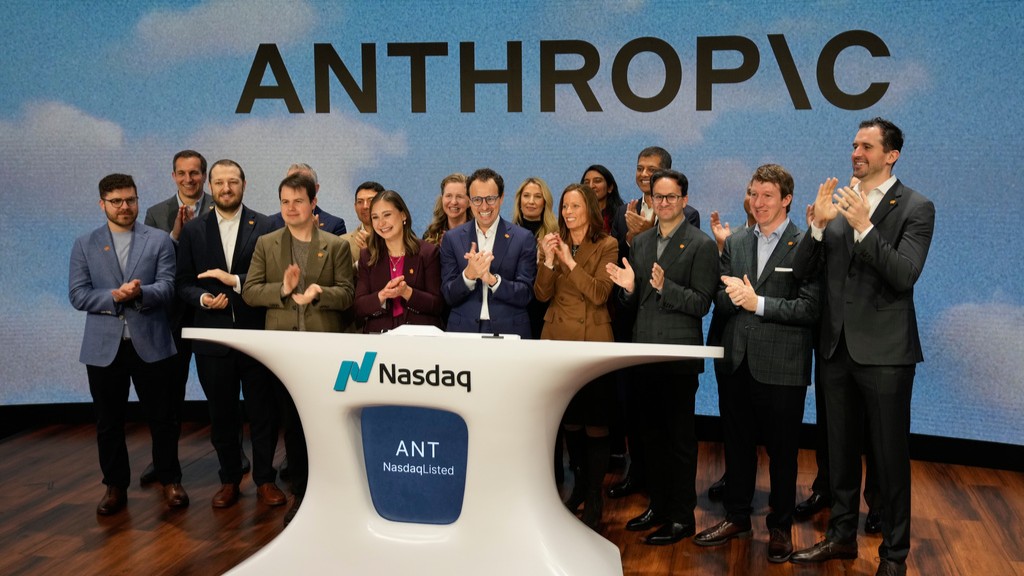

Artificial intelligence giant Anthropic began trading on the Nasdaq on Thursday at a price of $111.50 a share, though the price dropped to $97.17 a share by the close of trading.
Still, the company behind popular chatbot Claude occupied rarefied air among some of the largest public companies in the world.
Anthropic's stock closed well above an offer price of $83 a share, which had valued the company at about $1.5 trillion.
Dan Ives, a stock analyst at Yorkville Ives who focuses on tech, said on Thursday the stock debut provided a gauge of investor appetite for frontier AI models of the type made by Anthropic. Those models, in turn, fuel many AI products.
"The AI revolution gets its public scoreboard," Ives said of Anthropic's stock listing.
Even as Anthropic rose above its IPO price on Thursday, the broad stock indexes tumbled.
The Dow Jones Industrial Average closed down 1,100 points, or 2.1% while S&P 500 dropped 2%. The tech-heavy Nasdaq declined 2.2%.
The drop in overall markets owed in part to an uptick in demand for Anthropic, which prompted some investors to sell shares in other firms, Mohammed El-Erian, former CEO and co-CIO of investment management firm PIMCO, said on social media.
"Remember this isn't just about the promise of AI, but about making room for it," El-Erian said on X. "In a narrow sense, investor financing of the mega-IPO involves making room by selling other holdings."
The Anthropic IPO arrived at a tumultuous moment for the AI industry.
Public concern over potential catastrophic risks posed by AI has grown in recent months, resulting in part from security incidents disclosed by Anthropic as well as the high-profile resignation of a researcher at the company.
Nvidia, a high-flying AI firm and a partner of Anthropic, suffered a leadership shakeup last week as CEO Jensen Huang stepped down over allegations of an affair with a suspected Chinese intelligence asset. The tech-heavy Nasdaq is down about 4% since Huang resigned.
Huang admitted in an internal message to Nvidia staff that he had been "unfaithful to his wife," though he did not name the person with whom he had been involved.
Here's what to know about the Anthropic IPO:
Why did Anthropic move forward with an IPO?
The IPO pulled in fresh funds for the San Francisco-based firm, which aims to compete in a potentially lucrative but cost-intensive section of the AI industry centered on advanced models and the tools they empower.
"Building and scaling frontier intelligence is one of the most important and capital-intensive endeavors in history," Anthropic said in a filing with the Securities and Exchange Commission (SEC).
Anthropic priced its initial public offering of 980 million shares at $83 a share -- raising $81 billion. Anthropic traded under the ticker symbol "ANT."
The company significantly expanded its revenue at the outset of 2026, but it continued to suffer losses.
Anthropic earned $16.3 billion in revenue over the first six months of this year, growing nearly 14-fold from the same period a year earlier, according to a government filing.
Top Stories



Still, the company reported a net loss of $80.7 billion over the first six months of this year, indicating the scale of its spending over that period.
Did the Anthropic IPO make the company's founders billionaires?
Anthropic boasts seven co-founders, and each of them was expected to become a multi-billionaire after the company went public.
The most well-known co-founder is CEO Dario Amodei, who has drawn attention for repeated warnings about the risks posed by AI.
The company's other founders are Daniela Amodei, the company's chair, president and Dario's sister; Tom Brown, chief compute officer; Jack Clark, head of public benefit; Jared Kaplan, chief science officer; Sam McCandlish, chief architect; and Christopher Olah, interpretability research lead.
The founders each hold a stake of 3.6% to 3.7% of the company's voting common shares, and they each planned to sell a small portion of their stake when the company went public, according to a financial filing.
At the previously anticipated share price of $70 to $78, the portion of the stake to be sold by each one would have amounted to about $250 million. The remaining stake held by each -- about 3.2% -- would have been valued at more than $17 billion.
Will Anthropic stock be in your 401(k)?
Anthropic will all but certainly become a part of people's 401(k) accounts soon. Those accounts often hold index funds, which are pegged to major indexes like the Nasdaq.
Until recently, newly listed companies were barred from major indexes until after an extended waiting period. But the Nasdaq issued a rule change in May permitting "fast entry" to the Nasdaq-100 for some major IPOs. Over the ensuing weeks, some other top exchanges also tweaked their rules, though their eligibility requirements vary.
"Although Anthropic is unlikely to join the S&P 500 before late 2027 because of eligibility requirements, it is expected to be added to other indexes relatively soon after listing," Brian Therien, senior analyst at Edward Jones, told ABC News in a statement.
As such, it won't take long for Anthropic to become a part of 401(k) holdings.
What do analysts think of the stock?
In the run-up to its IPO, Anthropic touted AI as a transformational and lucrative technology, while warning about possible catastrophic risk that could bring financial fallout for shareholders.
A financial filing last month presents AI as "one of the most consequential technologies in human history. If managed well, it could rapidly accelerate scientific innovation, greatly increase economic growth rates, bring cures for major diseases within reach, and solve problems that have resisted generations of human effort."
In the same document, Anthropic warned of the possibility its AI models could pose a "catastrophic or existential risk to humanity."
Investing in the company's stock "involves a high degree of risk," Anthropic added.
In a report ahead of the IPO, financial research firm Morningstar voiced optimism about the stock but also cautioned about a very high degree of uncertainty surrounding the firm's prospects.
"We have a positive outlook on Anthropic's ability to remain at the frontier of artificial intelligence model research," Morningstar said, adding that the company could monetize such research by "selling primarily to enterprise customers."
Still, Morningstar said its warning about uncertainty "reflects our view on the wide range of financial outcomes for a business investing heavily in large language models, a nascent technology."